
Exit Readiness Coach vs M&A Adviser: What’s the difference?
If you’re thinking about selling your IT business in the next few years, you may eventually start looking for professional help.
And one of the people you might speak to is a mergers and acquisitions (M&A) adviser.
But if I describe myself as an Exit Readiness Coach, that raises an obvious question:
What’s the difference between an Exit Readiness Coach and a Mergers and Acquisitions (M&A) adviser?
It’s an important distinction because, although both may be involved in an owner’s journey towards a potential business exit, we do very different things.
The simplest way I can explain it is this:
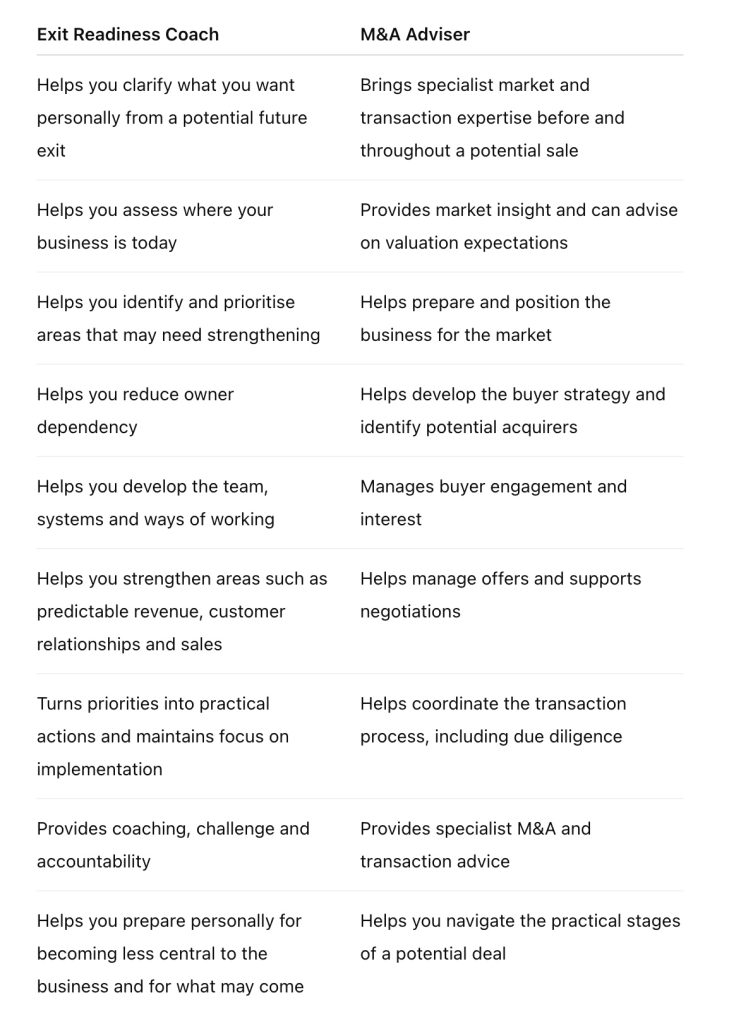
An Exit Readiness Coach helps you work on yourself and your business as you prepare for the possibility of a future exit.
An M&A adviser brings specialist transaction and market expertise, helping you prepare for and navigate a potential sale.
The two roles can overlap at certain points, but their primary focus is different — and they can be highly complementary.
And understanding where each fits can help you get the right support at the right stage.
Where does an Exit Readiness Coach fit?
Imagine you own an IT business and think you might like to sell it in two or three years.
You’re not ready to put it on the market.
You may not even know exactly when you want to sell.
But you’ve started thinking about the future.
Perhaps you’re still heavily involved in the day-to-day running of the business.
Maybe too many decisions come through you.
Revenue is healthy, but you’d like more of it to be predictable or recurring.
You have a good team, but you’re not convinced the business could operate successfully without you.
Some important processes are documented, while others still exist mainly in people’s heads.
Customer relationships may still depend heavily on you or a handful of key people.
And perhaps you haven’t really thought about what you personally want life to look like after the business.
This is where exit readiness coaching can help.
My role isn't to value your business, find a buyer or negotiate a sale.
It’s to help you step back from the day-to-day, think about what you want, assess where the business is today and decide what may need to change if a potential future exit is genuinely on your horizon.
What does exit readiness coaching involve?
Every business and every owner is different.
But there are a number of areas I believe are worth exploring when you begin preparing for a potential future exit.
Owner dependency
How much does the business still rely on you?
What decisions still come through you?
What would happen if you stepped away for a month?
Reducing owner dependency can take considerable time because it may involve developing people, delegating responsibility, changing roles and gradually allowing other people to make decisions you’ve historically made yourself.
And there’s a personal side to this too.
After years of being central to your business, are you ready to become less important to its day-to-day operation?
Team and leadership
Do you have the right people in the right roles?
Is there a leadership team capable of operating the business without your constant involvement?
Where are the gaps?
Developing a capable team isn't something that normally happens a few months before a sale. People need time to grow into roles, take responsibility and demonstrate that the business doesn't depend entirely on its owner.
Revenue
How predictable is your revenue?
What proportion comes from recurring or contracted services, managed services, software licensing or other repeatable sources?
How much depends on winning the next large project?
The objective isn't necessarily to turn every source of revenue into a recurring service.
It’s to understand the revenue profile of the business and identify opportunities to make future revenue more visible and predictable.
Customers
How concentrated is your customer base?
Would losing one or two customers have a significant impact?
Who owns the key customer relationships?
If important relationships depend almost entirely on you, broadening those relationships across the business may deserve attention.
Sales
Can your business consistently generate opportunities and win new customers without you?
Or are you still the person who brings in many of the important opportunities and helps close the major deals?
A business that can continue generating sales without its owner is very different from one where the owner remains central to the sales process.
Financial visibility
Do you have timely, accurate information about how the business is performing?
Can you easily understand where revenue and profit come from?
Can you identify trends and explain the numbers?
Good financial visibility helps you run the business today as well as understand it from the perspective of a potential future exit.
Systems and processes
How repeatable is the way the business operates?
Are important processes documented?
Could somebody else understand how things work without having to ask you?
Reducing reliance on knowledge held inside the heads of the owner or a handful of key employees can make the business more robust.
Positioning
Is it clear what your business does, who it does it for and why customers choose you?
Or has the business accumulated numerous services and offerings over the years?
Clear positioning can make a business easier to understand, easier to sell for and easier for somebody else to see how it can continue to grow.
Risk
Are there issues that might deserve attention well before a potential sale?
Contracts, intellectual property, supplier dependencies, customer concentration, compliance or other risks can all be worth identifying early.
An Exit Readiness Coach doesn't replace the legal, accounting or specialist advice required in these areas.
The coaching role is to help you identify what deserves attention, decide what to prioritise and make sure progress actually happens.
So what does an M&A adviser do?
At some point, your preparation may reach a different stage.
You may decide:
“I think I'm genuinely ready to explore selling the business.”
That’s when the professional team involved in an actual transaction becomes increasingly important.
An experienced M&A adviser can help you understand the sale process and guide you through the steps involved in taking the business to market.
Depending on the adviser and the nature of the transaction, their work may include helping prepare the business for market, developing sale materials, identifying and approaching potential buyers, managing buyer interest, coordinating offers and supporting negotiations through the transaction process.
Alongside them, your accountant, solicitor and other specialist advisers will have important roles of their own.
This is specialist work.
And it isn't what I do as a coach.
The difference is largely about our primary focus
Although there can be overlap between the two roles, it can be helpful to think about how the support you need may change as your journey progresses.
One way of thinking about the distinction is to consider the journey in stages.
Stage 1 — “I might want to sell my business one day.”
This is the thinking stage.
What do I want personally? What would need to change? How ready is the business today?
Stage 2 — “I want to start preparing properly.”
This is where exit readiness coaching can be particularly valuable.
Assess the business. Identify priorities. Reduce owner dependency. Develop the team. Strengthen revenue visibility. Improve systems. Work on the areas that may take time.
Stage 3 — “I think the business may be ready to take to market.”
At this stage, the role of an experienced M&A adviser becomes increasingly important. They can provide market and valuation perspective, help prepare the business for market and begin planning how a potential sale process might be approached.
Stage 4 — “We're pursuing a sale.”
Valuation. Buyers. Offers. Negotiation. Due diligence. Legal agreements. Completion.
At this point, your M&A adviser, accountant, solicitor and other transaction professionals are central to the process.
There won't necessarily be a precise dividing line between those stages.
In fact, speaking to an M&A adviser earlier can sometimes provide useful perspective on what the market may look for.
But the fundamental distinction remains:
Exit readiness coaching is about helping you and the business become better prepared.
M&A advice is about helping you navigate the process of pursuing and completing a transaction.
Coach vs M&A adviser at a glance
Why starting earlier matters
One of the reasons I make this distinction is that some of the most important preparation cannot be rushed.
You can produce a document fairly quickly.
You can engage an adviser.
You can start talking about valuation.
But developing a leadership team takes time.
Reducing owner dependency takes time.
Building predictable revenue takes time.
Embedding customer relationships across the business takes time.
Creating repeatable systems and processes takes time.
And preparing yourself to step away from something that may have occupied a significant part of your life for many years can take time too.
That’s why I believe exit readiness should start before you're ready to sell.
They are different roles — but part of the same journey
I don't see exit readiness coaching as an alternative to working with an M&A adviser.
Quite the opposite.
If you eventually decide to sell your business, having experienced professional advisers around you will be important.
My role comes earlier.
It’s helping you create the space to think about what you want, look objectively at the business you've built, identify what may need strengthening and then maintain focus on making those improvements.
The aim isn't simply to make your business ready for an adviser.
And it isn't to guarantee that somebody will eventually buy it.
It’s to help you build a stronger, less owner-dependent business that gives you more choice about what happens next.
Then, if the day comes when you decide:
“I'm ready to explore a sale.”
You can begin that conversation with an M&A adviser from a much stronger starting position.
Not sure where to start?
If you're an IT business owner beginning to think about a potential future exit, I've created the Exit Readiness Focus Framework as a practical place to start.
It helps you step back from the day-to-day, think about what you want personally, assess where your business is today and identify what deserves your attention first.
PAUSE → CLARIFY → PRIORITISE → COMMIT → PROTECT
The complete workbook is free to work through in your own time.