
The New Perspectives
FOCUS FRAMEWORK
FOR IT BUSINESS OWNERS
Helping you step back, clarify the future you want, decide what matters most, commit to action and protect your focus
This guide will take you step by step through the New Perspectives FOCUS FRAMEWORK, helping you apply it directly to your own business and to the future you want to create as its owner.
Before You Begin
I recommend downloading the accompanying workbook.
The workbook gives you dedicated space to capture your thinking, complete each exercise and build your FOCUS Plan as you progress through the framework.
You can, of course, simply read through this page first. But if you're ready to apply it to your own business, download the workbook and have it alongside you.
Download the New Perspectives FOCUS FRAMEWORK Workbook:
Free for personal use. By downloading this workbook, you agree to the Terms of Use.
INTRODUCTION
If you're reading this, there's a good chance your business isn't suffering from a lack of ideas.
It's suffering from too many.
One minute you're dealing with an urgent client issue.
The next you're trying to recruit a new engineer, review your cash flow, respond to a supplier, support your team, think about cybersecurity, win new business, improve your systems and somehow still find time to work on your long-term strategy.
By the end of the day, you've been busy from morning until evening...
...but you're not sure you've actually moved your business forward.
If that sounds familiar, you're not alone.
I've been there.
In 2004, together with two co-founders, I started an IT business from scratch.
Over the next fifteen years we experienced many of the challenges that some business owners know all too well: rapid growth, recruitment struggles, cash flow pressures, demanding customers, difficult decisions, long hours and the constant pressure of leading a growing company.
In 2019, we successfully exited the business after growing it to an eight-figure annual turnover.
People sometimes assume reaching that point meant everything became easier.
It didn't.
In many ways, the bigger the business became, the more demands competed for my attention.
Looking back, one of the biggest lessons I learned wasn't about sales, marketing or finance.
It was about focus.
I discovered that one of the biggest obstacles to making meaningful progress often isn't a lack of knowledge.
It's allowing too many competing priorities to pull your attention away from what matters most.
Since leaving the business, I've had the privilege of working with business owners from a variety of industries.
Although every business is different, one challenge appears again and again:
They're overwhelmed by the number of important things competing for their attention.
The solution isn't to work harder.
It isn't to become more productive.
And it certainly isn't to squeeze even more into an already busy day.
The answer is learning how to identify what matters most and focus your time, attention and energy on it.
That's what the New Perspectives FOCUS FRAMEWORK is designed to help you do.
Throughout this guide, I'll share practical ideas, coaching tools and lessons I've learned — both from building and exiting my own IT business and from helping other business owners regain clarity, focus on what matters most and move forward with greater confidence.
My hope is that by the time you reach the end of this guide, you'll have greater clarity about the future you want to create, a clearer understanding of what matters most, and a practical plan for focusing your time and attention where it can make the greatest difference.
Let's get started.
WHY FOCUS IS SO DIFFICULT
Running an IT business has never been more demanding.
Technology is evolving at an incredible pace.
Customer expectations continue to rise.
Cybersecurity threats become more sophisticated every year.
New competitors enter the market.
Vendors release new products.
Artificial intelligence is changing the way businesses operate.
At the same time, you're expected to lead your team, serve your customers, grow the business and somehow still have a life outside of work.
It's no wonder some business owners can feel overwhelmed.
The challenge isn't usually a lack of opportunities.
It's the opposite.
There are simply too many.
Every day presents another decision:
- Should we recruit another engineer?
- Should we invest in marketing?
- Should we improve our service desk?
- Should we launch a new service?
- Should we change our pricing?
- Should we implement a new system?
- Should we spend more time with existing customers?
- Should we pursue that large opportunity?
- Which AI model should we use?
Individually, each of these decisions may be worthwhile.
Together, they compete for your attention.
When everything feels important, it becomes increasingly difficult to decide what deserves your attention most.
I experienced exactly the same challenge while building our own IT business.
As the business grew, so did the number of opportunities available to us.
Every conversation seemed to uncover another possibility.
Every customer had another request.
Every supplier had another solution.
Every industry event introduced another idea worth exploring.
At first, it felt exciting.
Then it became exhausting.
Without realising it, we had allowed too many priorities into the business.
The result wasn't faster progress.
It was slower progress.
Our attention became fragmented.
Projects took longer to complete.
Decisions were delayed.
We were busy every day, yet it often felt as though we weren't moving forward as quickly as we should have been.
Looking back, I realised something important.
Focus isn't about working harder.
Most business owners already work incredibly hard.
It's about deciding what deserves your attention—and having the discipline to protect it.
It's easy to assume that making greater progress means doing more. In reality, it often means becoming more deliberate about where you invest your time, attention and energy.
Every new commitment comes at the expense of something else. Every “yes” is also a “no” to something that may matter more.
For some business owners, saying no can feel uncomfortable.
There may be a concern about disappointing a customer, missing an opportunity or turning away something that could prove valuable.
Saying no can feel risky.
You may worry about losing a customer, upsetting a supplier or letting a good opportunity pass by.
But trying to do everything carries an even greater risk.
It spreads your time, energy and attention so thinly that the things which matter most never receive the focus they deserve.
Over time, this creates a cycle that many business owners recognise.
You become busy.
You become reactive.
You spend your days responding rather than leading.
You finish each week feeling exhausted but frustrated that your biggest priorities remain untouched.
If any of this sounds familiar, you're not alone.
The good news is that focus isn't something you're born with.
It's a skill.
And like any skill, it can be developed.
Before we explore how to regain focus, it's worth understanding what losing focus is really costing your business—and your life.
Reflect on Your Business
Using the accompanying workbook to capture your thoughts, answer the following questions:
1. What are the biggest demands currently competing for your attention?
2. Where do you spend time each week that may not be making the best use of your time and attention?
3. Which important piece of work have you been postponing because you've been too busy dealing with urgent issues?
THE HIDDEN COST OF LOSING FOCUS
Being busy and being focused are not the same thing.
Being busy can be productive.
But when your attention becomes divided across too many competing priorities, the cost of losing focus isn't always obvious.
It won't appear as a line on your profit and loss statement, yet over time it can have a significant impact on your business.
Let's look at some of the hidden costs.
Slower Progress
When your attention is divided across too many priorities, everything takes longer.
Projects remain unfinished.
Decisions are postponed.
Opportunities lose momentum.
Rather than completing one important initiative and moving on to the next, you find yourself making small amounts of progress on many different things.
Greg McKeown, author of Essentialism, describes this as:
"Making a millimetre of progress in a million directions"
It's a powerful image—and one that many business owners recognise.
The result is frustration.
You know you're working hard, but your business doesn't seem to be moving forward at the pace you'd hoped.
Decision Fatigue
As a business owner, you're making decisions all day.
Some are small.
Others could shape the future of your business.
Every email, phone call, customer issue, supplier conversation and team question demands another decision.
Eventually, your mental energy begins to fade.
You become slower to decide.
You start postponing important choices.
Sometimes you choose the easiest option rather than the best one.
Good decision-making requires mental space, and that becomes increasingly difficult when your attention is constantly pulled in different directions.
Living in Reaction Mode
You might begin the day with good intentions and a clear plan.
Then reality takes over.
An urgent support issue.
A customer complaint.
A member of staff needs help.
An unexpected supplier issue.
A new opportunity appears.
By lunchtime, the carefully planned day has disappeared.
Of course, responding to unexpected events is part of running any business.
The problem comes when reaction becomes your default way of working.
Instead of leading your business, your business begins leading you.
Weeks turn into months, and the important work that will shape your future is continually pushed into next week.
Unclear Direction for Your Team
Your team looks to you for direction.
When the priorities of the business keep changing, it can become harder for your team to know where to focus.
People become unsure what success really looks like.
Projects start but never quite finish.
Meetings create activity but not always progress.
Without clear priorities, an organisation can become busy without necessarily becoming more effective.
Clear leadership starts with clear priorities.
Missed Opportunities
Ironically, trying to pursue every opportunity can mean giving too little attention to the opportunities that matter most.
Meaningful opportunities often require sustained attention:
They need planning.
Execution.
Consistency.
When your focus continually shifts, it's difficult to give those opportunities the time they deserve.
Sometimes success isn't about finding more opportunities.
It's about fully committing to the right ones.
The Personal Cost
Perhaps the greatest cost of losing focus isn't found in the business at all.
It's found at home.
When your attention is constantly consumed by the business, it can be difficult to leave it behind at the end of the working day:
Evenings become an extension of the working day.
Weekends become catch-up time.
Family conversations are interrupted by thoughts of unfinished work.
Even when you're physically present, your mind is somewhere else.
I've experienced this myself.
While running my IT business, I would often wake up in the early hours because I couldn't sleep.
Instead of trying to switch off, I'd open my laptop and start working.
It wasn't unusual for me to work late into the evening, spend much of the weekend catching up, or even work whilst on holiday.
At the time, it simply felt like part of being a business owner.
Looking back, I realise I wasn't just working hard—I had lost focus on what mattered most.
Running a business can be hugely rewarding, but the demands of it can gradually consume more and more of your time and attention.
One of the reasons I became a business coach is because I believe success shouldn't come at the expense of your health, your relationships or your enjoyment of life.
Building a successful business and enjoying a better life shouldn't be opposing goals.
They should go hand in hand.
A Different Way Forward
The encouraging news is that losing focus doesn't have to be permanent.
As the demands on your business increase, it's easy for your attention to become fragmented across too many competing priorities.
The important thing is recognising when that's happening.
Once you understand the cost of losing focus, you can begin making different choices.
And those choices start with a different way of thinking.
In the next chapter, we'll explore one of the most powerful ideas I've discovered during my own business journey: becoming more deliberate about what deserves your time, energy and attention.
But before we do that, pause and reflect on your business:

Reflect on Your Business
Using the accompanying workbook to capture your thoughts, answer the following questions:
1. Looking back over the last six months, what has losing focus cost your business?
2. How has your business affected your personal life, health or relationships?
3. If nothing changed over the next twelve months, what would concern you most?
A DIFFERENT WAY OF THINKING
By this point, you may be thinking:
"That sounds exactly like my business... but what do I do about it?"
Before we look at practical tools and the framework, I'd like to introduce one idea that completely changed the way I think about business.
It's a way of thinking that helped me make better decisions, reduce unnecessary complexity and focus more of my attention on what really mattered.
It's called Essentialism.
The concept was popularised by Greg McKeown in his excellent book Essentialism: The Disciplined Pursuit of Less.
At its heart is a simple but powerful idea:
If you don't prioritise your life, someone else will.
In business, it's easy to assume that success comes from doing more:
More customers.
More services.
More meetings.
More emails.
More projects.
More opportunities.
More hours.
But what if the opposite were true?
What if building a better business wasn't about doing more...
...but about doing less, better?
That doesn't mean becoming lazy or lowering your ambitions.
It means becoming deliberate.
It means recognising that every time you say "yes" to one thing, you're automatically saying "no" to something else.
Time is limited.
Energy is limited.
Attention is limited.
Once you accept that, every decision becomes more intentional.
The Power of Choice
One of the biggest lessons I learned while growing our IT business was that not every opportunity deserves to be pursued.
Some opportunities looked exciting but distracted us from our long-term goals.
Others promised quick wins but consumed enormous amounts of time and energy.
Some customers generated good revenue but demanded disproportionate amounts of our attention.
Not every opportunity was the right opportunity.
The same is true today.
Every new idea comes with a hidden cost.
Every commitment consumes time that can never be recovered.
Every distraction delays something more important.
A more focused way of thinking is to stop asking:
"How can I fit this in?"
And start asking:
"Is this important enough to deserve my time?"
That single question can transform the way you lead your business.
The Courage to Say No
For some business owners, saying no feels uncomfortable.
We don't want to disappoint people.
We don't want to miss an opportunity.
We don't want to lose a customer.
But every unnecessary "yes" reduces your ability to give your best to the things that matter most.
Saying no isn't about being negative.
It's about protecting what matters.
Developing this discipline takes time.
It isn't about enjoying saying no.
It's about understanding that every unnecessary ‘yes’ takes time, energy and attention away from what matters most.
Clarity Before Action
One mistake I see some business owners make is trying to improve execution before they've achieved clarity.
They ask questions like:
"How can I become more productive?"
"Which software should I use?"
"How do I manage my time better?"
These are useful questions.
But they're not the first questions that should be asked.
The first question is:
"What deserves my attention in the first place?"
There's little value becoming more efficient at doing things that don't really matter.
Clarity must come before action.
Focus must come before momentum.
A Better Way Forward
Focus isn't about doing less for the sake of it.
It's about making deliberate choices.
Choosing where your time creates the greatest value.
Choosing which opportunities move you towards the future you're trying to create.
Choosing what deserves your attention now.
When you make those choices consistently, something remarkable happens.
The noise begins to disappear.
Decision-making becomes easier.
Your team gains greater clarity.
Your energy returns.
Most importantly, you begin making meaningful progress again.
In the next chapter, I'll introduce the practical framework I use in my own business and with my coaching clients to cut through the noise, regain focus and move forward with greater clarity and confidence.
Reflect on Your Business
Using the accompanying workbook to capture your thoughts, answer the following questions:
1. What is one commitment, project or activity you could stop doing?
2. What deserves significantly more of your attention than it currently receives?
3. What might become possible if you were more deliberate about where you invested your time and attention?
THE NEW PERSPECTIVES FOCUS FRAMEWORK
By now, you've seen why some IT business owners lose focus.
You've explored the hidden cost of trying to do too much, the importance of thinking differently, and the value of choosing what truly matters.
Understanding the problem is an important first step.
But understanding alone doesn't create change.
Real change comes from taking deliberate action.
Over the years, both as a business owner and now as a business coach, I've learned that the biggest breakthroughs rarely come from working harder.
They come from creating the time and space to think more clearly, asking better questions and making better decisions.
That's why I developed the New Perspectives FOCUS FRAMEWORK.
It's a simple, practical framework designed to help IT business owners step back from the day-to-day operation of their business, regain clarity and make confident decisions about what matters most.
It's not a rigid process or a checklist to complete once.
It's a way of thinking.
A framework that you can return to whenever your business begins to feel overwhelming, priorities become blurred or you find yourself reacting instead of leading.
The framework consists of five stages.
Together, they provide a practical, structured process for stepping back from the day-to-day, deciding what matters most and turning that clarity into focused action.
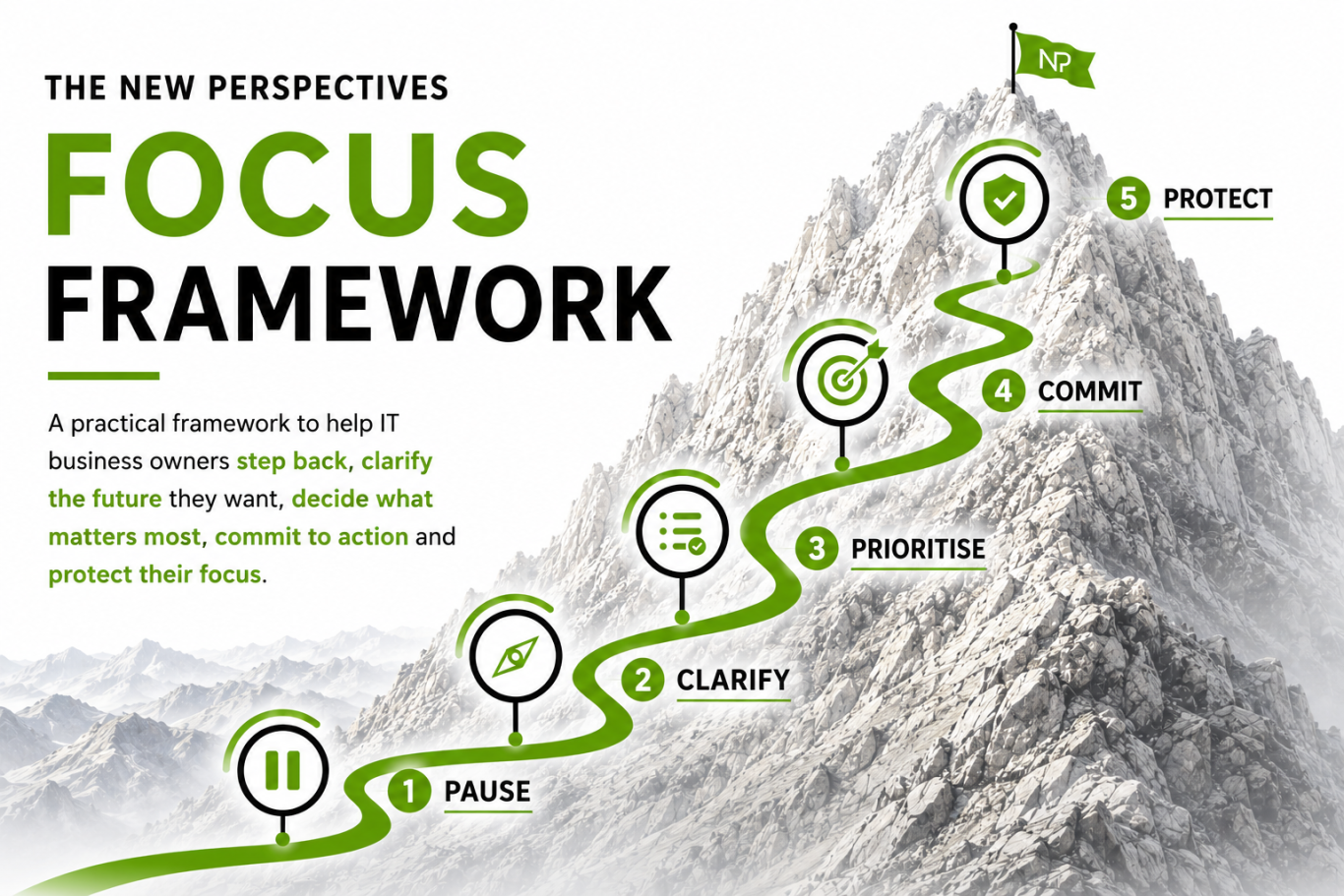
The New Perspectives FOCUS FRAMEWORK is designed to help you move from reacting to leading — making more deliberate decisions about where your time, attention and involvement can make the greatest difference.
In this guide, we'll explore each stage in more detail and, more importantly, how you can apply the framework to yourself and your business.
HOW TO GET THE MOST FROM
THE FOCUS FRAMEWORK
The FOCUS FRAMEWORK is designed to help you think — not to give you another complicated system to manage.
As you work through the five stages, you'll find questions, reflection exercises and practical tools designed to help you capture your thinking, explore what's important and make deliberate decisions about where your focus should go.
Use the FOCUS FRAMEWORK Workbook to record your thoughts as you go.
Don't feel you need to rush.
Some questions may be easy to answer. Others may require you to step back, reflect and come back to them.
As you work through PAUSE — CLARIFY — PRIORITISE — COMMIT — PROTECT, your thinking will gradually be distilled into a small number of important decisions:
- Your Desired Future
- Your Motivation
- The Business Priorities and who owns them
- Your Priority
- Your 90-Day Outcome
- Your Action Steps
- The other responsibilities you've consciously chosen to DO
- How you'll protect and regularly review your focus
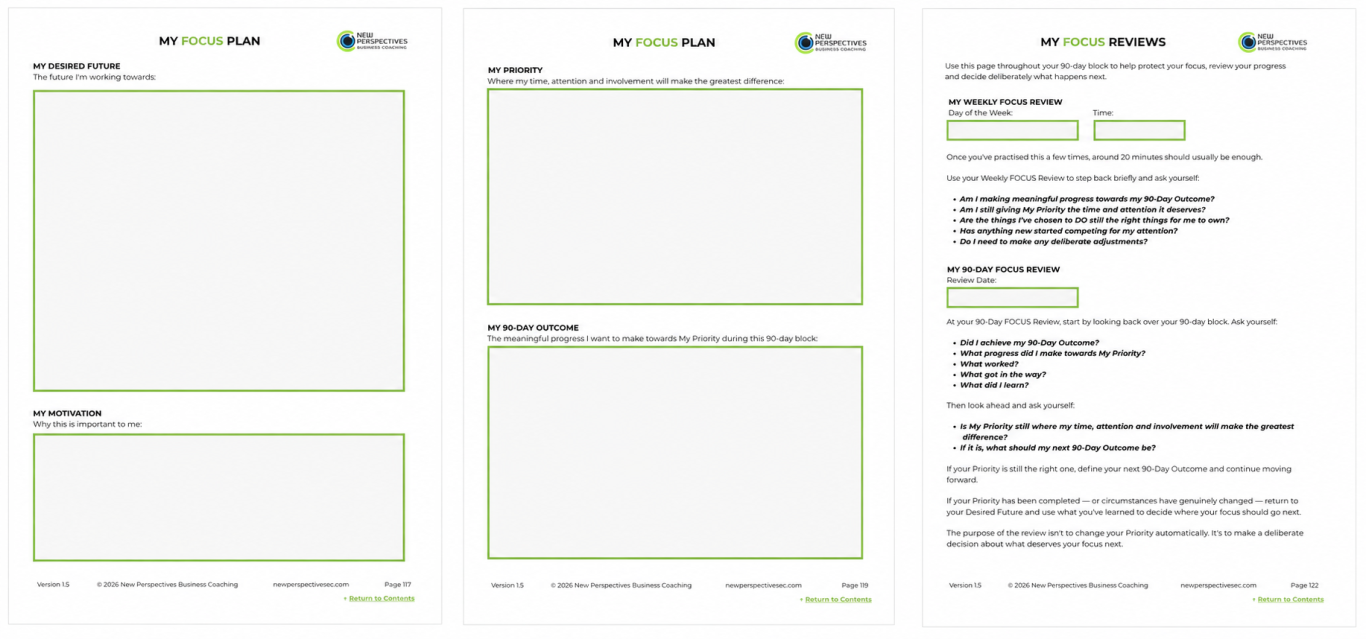
At the end of the workbook, you'll bring those decisions together in your simple FOCUS PLAN.
MY FOCUS PLAN captures the key decisions you've made and what you're committing to during your 90-day block.
MY FOCUS REVIEWS contains the questions you'll use for your Weekly FOCUS Review and 90-Day FOCUS Review.
You don't need to keep returning to every exercise you've completed.
The workbook helps you do the thinking.
Your FOCUS PLAN helps you keep that thinking visible and turn it into action.
Work through the framework one stage at a time, give yourself the space to think honestly, and let each stage build on the one before it.
A Preview of Your FOCUS Plan and FOCUS Reviews
At the end of the workbook, you'll bring your key decisions together in your FOCUS Plan and use your FOCUS Reviews to help you protect your focus and review your progress:
PREPARING TO FOCUS
Before you begin working through the New Perspectives FOCUS FRAMEWORK, take time to prepare properly.
This isn't an exercise to complete between meetings or while multitasking.
The value you'll gain from the framework is directly linked to the quality of the time you invest in it.
I encourage you to schedule a dedicated FOCUS Session in your diary to work through the framework.
Allow around two to three hours to work through the framework.
Treat it as one of the most important appointments you'll make this year and protect that time from other commitments.
The objective isn't to solve every problem immediately.
It's to create the time and space to think more clearly, ask better questions and decide what matters most.
If possible, choose somewhere away from the office where you won't be interrupted.
Use the accompanying workbook to capture your thoughts and come with an open mind.
Give yourself permission to step away from the day-to-day operation of your business.
Don't rush this process.
The decisions you make during your FOCUS Session could shape the direction of your business for months—or even years—to come.
Give yourself the time and space to do this properly.
1 - PAUSE
Create the space to think
When things become difficult, it can be tempting to respond by working harder — putting in longer hours, attending more meetings and trying to tackle every challenge yourself.
Unfortunately, this often creates more noise rather than more progress.
The first stage of the New Perspectives FOCUS FRAMEWORK is deliberately different.
Before making decisions, setting priorities or creating action plans, you need to pause.
Create the space to step back from the day-to-day, gain perspective and think clearly.
Now that you've created the time, it's important to protect it.
Turn your phone onto silent.
Close your email.
Remove as many distractions as possible.
This is your opportunity to think without interruption.
Pausing gives you the opportunity to step back and look at your business objectively.
It allows you to move from reacting to leading.
It creates the mental space to ask better questions, challenge assumptions and see opportunities that are often hidden by the demands of everyday business life.
Business owners occasionally tell me they don't have time to stop.
I'd suggest they don't have time not to.
Some of your most valuable decisions are unlikely to happen in the middle of a busy Monday morning.
They'll happen when you've deliberately created the time and space to think clearly.
Don't underestimate the value of simply slowing down.
It's often the first step towards making better decisions and becoming a more intentional leader.
You can't make better decisions until you create the time and space to think more clearly.

Using the workbook to capture your thoughts, answer the following questions:
There are no right or wrong answers. The purpose is simply to increase your awareness before moving to the next stage.
1. When was the last time you deliberately stepped away from your business to think strategically rather than operationally?
2. What distractions or habits regularly prevent you from creating time to think?
3. If you gave yourself one uninterrupted day to focus on your business, what would you most want to understand, resolve or create?
2 - CLARIFY
Get clear on the future you want
It's impossible to make good decisions if you don't have a clear destination.
When you're busy working hard, solving problems and responding to whatever comes your way, it's easy to lose sight of one simple question:
“Am I building the business I actually want?”
Without clarity, it's easy to mistake activity for progress.
You can have a full diary, a growing list of customers and a busy team, yet still feel like you're drifting rather than moving with purpose.
That's why the second stage of the New Perspectives FOCUS FRAMEWORK is all about clarity.
Before you decide what deserves your attention, you first need to understand two things:
- Where are you today?
- Where do you want to go?
Where Are You Today?
Start by taking an honest look at your current situation:
- What is working well?
- What isn't?
- Where are the biggest challenges?
- What opportunities are you overlooking?
Be objective.
Avoid telling yourself the story you want to believe and instead focus on the reality of where your business stands today.
Where Do You Want to Go?
Now turn your attention to the future.
This isn't about creating a formal vision statement for your company.
That may be something you develop separately with your leadership team.
This is more personal.
It's about getting clear on what you want the future to look like — for your business, for your role within it and for your life as its owner.
Ask yourself:
“If my business was exactly as I wanted it to be three years from now, what would that look like?”
There is no single right answer.
You might want to:
- Grow the business significantly in revenue and profitability
- Build a stronger management team and step back from the day-to-day running of the company
- Prepare the business for sale or exit within the next three years
- Stop pursuing growth and instead build a more profitable, predictable and manageable business
- Reduce the number of hours you work and create more time for your family and life outside the business
- Regain the enjoyment and sense of purpose you once had from running the company
- Create greater financial freedom and more choice about what you do next
Your Desired Future may include several of these things — or something completely different.
The important thing is that it reflects what success genuinely looks like for you, rather than somebody else's definition of what a successful business owner should want.
Think about:
- What kind of business do you want to own?
- What role do you want to have within it?
- How involved do you want to be in the day-to-day operation?
- What do you want the business to achieve financially?
- How do you want the business to support the life you want to live?
- What would you like the business to make possible for you in the future?
Don't define success by what you think your business should look like or by comparing yourself with other business owners.
Define it by what matters most to you.
We're going to call this your Desired Future.
Your Desired Future is the picture of what you want your business, your role within it and your life as its owner to look like in the years ahead.
You'll use your Desired Future throughout the FOCUS FRAMEWORK as a filter for deciding what needs to change, what matters most and where your own time, attention and involvement can make the greatest difference.
Understand Your Motivation
Getting clear about your Desired Future is important.
But there's another question worth exploring:
Why does that future matter to you?
Most business owners started their business with some kind of ambition.
Perhaps you wanted greater freedom and independence.
Maybe you wanted to build something of your own, create financial security for your family, prove what you were capable of, make a difference for your customers, or simply enjoy doing work on your own terms.
Over time, it's easy to lose connection with that original motivation.
The pressures of running the business take over:
- Customers need attention
- Employees need support
- Problems need solving
- Opportunities appear
Before long, much of your energy is spent dealing with what's immediately in front of you rather than remembering why you're doing it in the first place.
Your Desired Future gives you a destination.
Your Motivation gives you a reason to move towards it.
Ask yourself:
“What will achieving my Desired Future give me?”
Then go a little deeper:
“Why is that important to me?”
Don't look for the answer you think you should give.
Your Motivation is personal.
It might be greater freedom, financial security, more time with your family, the satisfaction of building something valuable, the opportunity to pursue something new, or simply the feeling that you're back in control of your business and your life.
We're going to call this your Motivation.
Your Motivation is the personal reason your Desired Future matters to you.
Keep it in mind as you work through the rest of the FOCUS FRAMEWORK.
When difficult choices need to be made, reconnecting with why your Desired Future matters can help you stay committed to the future you're trying to create.
An Example — Meet James
To see how the FOCUS FRAMEWORK works in practice, let's introduce James — a fictitious IT business owner we'll follow through the five stages.
James owns an established IT services business with a team of 25 people.
The business is successful, but it remains heavily dependent on his day-to-day involvement.
Like many business owners, James doesn't have just one thing he wants to change.
When he thinks about where he'd like to be three years from now, his Desired Future includes several elements.
He writes:
- Grow the business and improve profitability, with a greater proportion of predictable, recurring managed-service revenue.
- Build a stronger management team and reduce the business's dependence on me, with greater responsibility for day-to-day operations and decisions owned by the team.
- Change my role within the business, spending less time on day-to-day operations and more time on leadership, strategy, key relationships and the areas where I can add the greatest value.
- Create more freedom outside the business, with fewer long days and more time for my family, interests and life away from work.
- Build a more valuable, saleable business, with the option to begin preparing for a potential sale over the next three years and exit around two years later if the timing and circumstances are right.
Together, these elements create a much clearer picture of the business James wants to build, the role he wants to play in it and the life he wants it to support.
That's his Desired Future.
As we work through the FOCUS FRAMEWORK, we'll return to James to see how his Desired Future influences what needs to change, what matters most and where his own time, attention and involvement can make the greatest difference.
But James goes one step further.
He asks himself what achieving that Desired Future would actually give him.
For James, it's about more than growing revenue, improving profitability or eventually selling the business.
It would give him greater freedom and choice.
He'd be able to step away from the constant pressure of day-to-day operations, spend more time with his family and enjoy life outside the business without always feeling that the company needed him.
And by building a stronger, less owner-dependent business, he'd know that the years of hard work had created something genuinely valuable — something that could eventually give him the financial freedom and choice to decide what he wanted to do next.
That's important to James because he doesn't want to spend the next five years simply working harder and becoming more deeply tied to the business he's built.
He writes:
MY MOTIVATION - To create greater freedom and choice for myself and my family, knowing I've built a valuable business that can succeed without depending on me.
That's James's Motivation — the personal reason his Desired Future matters to him.
See the Gap
When you have a clear picture of both your current reality and your Desired Future, the gap between the two becomes visible.
That gap helps you identify what needs to change.
It also becomes easier to recognise the obstacles that may be holding you back.
Some will be external.
Others may be habits, assumptions, ways of working or decisions that no longer serve you.
Clarity doesn't solve every problem.
But it gives you a much stronger basis for making decisions because you're no longer reacting only to today's pressures.
You're making choices based on your Desired Future.
Identify What Needs to Change
Once you're clearer about your Desired Future, the next step is to consider what needs to change within the business to move you towards it.
Ask yourself:
“What needs to change, improve or be created within my business to move me closer to my Desired Future?”
Don't prioritise your answers yet.
At this stage, you're simply identifying the areas where progress may be needed.
Try to keep each item distinct and avoid listing it in several different ways, and don't turn the list into detailed tasks or Action Steps — those come later.
Think in terms of the meaningful changes, improvements or developments the business may need to make.
We're going to call this the Business Progress List.
James Identifies What Needs to Change
James returns to his Desired Future and considers what would need to change within the business to move him closer to it.
He identifies the:
BUSINESS PROGRESS LIST
- Build a stronger management team
- Increase recurring managed-service revenue
- Improve operational processes and systems
- Improve management information and financial visibility
- Strengthen customer retention
- Improve gross margins
- Improve the business's readiness for a future sale
- Launch a new software product
James doesn't try to decide which of these matters most yet.
Some may prove much more important than others. Some may be delegated, delayed or even removed altogether.
For now, he's simply identifying the areas where progress could help move the business towards his Desired Future.
He'll decide what matters most in Stage 3 — Prioritise.
Understand Where Your Time & Attention Are Going
There's one more part of your current reality to clarify.
Where is your own time and attention going today?
As the business owner, it's easy for your working week to become filled with activities, responsibilities and decisions simply because you've always handled them.
Some will genuinely require your involvement.
Others may no longer deserve it.
But don't make those decisions yet.
For now, look honestly at where your time and attention are currently going.
We're going to call this your Time & Attention List.
James Looks at His Time & Attention
James considers what typically consumes his working week.
He writes his list:
MY TIME & ATTENTION LIST
- Responding to customer issues and escalations
- Answering questions from employees
- Attending internal meetings
- Getting involved in technical and operational problems
- Reviewing and approving quotes and proposals
- Supporting sales and key customer relationships
- Dealing with recruitment and people issues
- Reviewing financial and business performance
- Working on business strategy
- Exploring new business opportunities and ideas
- Dealing with emails, messages and administration
- Making decisions that others regularly bring to me
- Stepping in when something isn't getting done
- Producing a weekly management report
Looking at the list, James can see just how much of his time is still being consumed by the day-to-day operation of the business.
He doesn't decide what to continue doing, delegate, delay or stop doing yet.
Just as with the Business Progress List, that decision comes next.
In Stage 3 — Prioritise, James will use these lists to decide what matters most for the business and where his own time, attention and involvement can make the greatest difference.

One of the first things I ask every coaching client is:
“What does success look like for you?”
It's a simple question, but it's often one of the hardest to answer.
Don't define success by what you think your business should look like or by comparing yourself to others.
Define it by what matters most to you.
Then take it one step further.
Ask yourself:
“What would achieving that give me?”
And then:
“Why is that important to me?”
Sometimes the first answer is a business outcome — more revenue, greater profitability, a bigger team, less owner-dependence or eventually selling the business.
But that's rarely the whole story.
Behind those outcomes is often something much more personal: freedom, security, time with your family, greater choice, a sense of achievement, or simply enjoying running your business again.
That's your Motivation.
Once you're clear about your Desired Future and understand why it matters to you, you have something much stronger to guide the decisions that follow.
The clearer you are about the future you want to create — and why it matters to you — the easier it becomes to decide what matters most now.
Your Desired Future gives you direction.
Your Motivation gives you a reason to keep moving towards it.
Together, they provide the clarity you need to make better choices about where to focus your time, attention and involvement.
Now it's your turn.
Using the accompanying FOCUS FRAMEWORK Workbook, work through the following four exercises and capture your thinking as you go.
1. Define Your Desired Future
Ask yourself:
“If my business and my role within it were exactly as I wanted them to be three years from now, what would that look like?”
Consider your business, your role within it, how involved you want to be in the day-to-day operation, and what you want the business to make possible for you.
Describe your Desired Future in as much detail as you need.
It doesn't need to be a single goal.
It may include several elements that, together, describe the business you want to build, the role you want to play within it and the life you want it to support.
Don't limit your thinking.
2. Define Your Motivation
Now think about why your Desired Future matters to you personally.
Ask yourself:
“What will achieving my Desired Future give me?”
Then ask:
“Why is that important to me?”
Try to get beneath the business outcomes themselves.
Perhaps it's freedom, security, time, choice, fulfilment or something entirely different.
Capture the reason that matters most to you in MY MOTIVATION in the workbook.
3. Create The Business Progress List
Ask yourself:
“What needs to change, improve or be created within my business to move me closer to my Desired Future?”
Think in terms of the meaningful changes, improvements or developments the business may need to make.
Keep each item distinct and at a similar level.
Avoid listing the same item in different ways, outcomes that would naturally result from another item, or detailed Action Steps you might take later.
Don't prioritise anything yet.
Capture everything that could help move you and your business closer to your Desired Future in the BUSINESS PROGRESS LIST in the workbook.
4. Create Your Time & Attention List
Think about a typical working week.
Ask yourself:
“What activities, responsibilities and demands currently consume my time and attention as the business owner?”
Include both the things you deliberately choose to do and the things you regularly find yourself being drawn into.
Don't worry yet about whether you should be doing them.
For now, simply create an honest picture of where your time and attention are going today.
Capture them in MY TIME & ATTENTION LIST in the workbook.
You'll use both lists in Stage 3 — Prioritise to decide what matters most for the business and where your own time, attention and involvement can make the greatest difference.
3 - PRIORITISE
Choose what matters most
By now, you've created the space to think.
You've gained greater clarity about where your business is today, the future you want to create as its owner, why that future matters to you, what needs to change to move towards it, and where your own time and attention are currently going.
The next step is deciding what matters most now — both for the business and for you as its owner.
This is where some business owners struggle.
Customers, employees, operations, finance, sales and marketing, technology, cybersecurity, AI, new opportunities and long-term strategy can all demand attention.
They may all be important.
But everything can be important without everything being a priority.
Trying to make progress on too many things at once usually results in slower progress on all of them.
Prioritisation means making deliberate choices about what deserves your focus now — and what doesn't.
Use Your DESIRED FUTURE as a Filter
Return to the Desired Future you defined in Stage 2 — Clarify.
Perhaps you want to grow the business, improve profitability, step back from its day-to-day operation, reduce its dependence on you or prepare it for an eventual sale.
Use your Desired Future as a filter for deciding what matters most.
Ask yourself:
“Given my Desired Future, which of these will make the greatest difference if I get it right?”
Without that filter, it's easy to prioritise whatever is loudest, newest or most urgent.
With it, you can make more deliberate choices.
The Business Priorities and Your Priority
Return to the Business Progress List you created in Stage 2 — Clarify.
Use your Desired Future as your filter and consider which items matter most in moving the business towards it.
Then consider how many of those items your business can realistically make meaningful progress on at the same time.
Identify the fewest Business Priorities your business needs to focus on now.
Deciding how many Business Priorities your business can realistically progress at the same time is a judgement call.
If you work on your own, I strongly recommend focusing on one Business Priority at a time.
If you have a team, consider the scale and complexity of each potential priority, the people available to work on it, their existing responsibilities, and the time and resources it will require.
Having more people doesn't automatically mean your business should have more priorities. A significant priority may require much of the available capacity of even a larger team.
If you believe your business genuinely has the capacity to progress more than one Business Priority without diluting its focus, you may choose two or three.
I suggest that three should be the maximum.
Every additional priority requires time, attention and resources. As the number of active priorities increases, so does the risk of spreading people and resources too thinly and making slower progress on what matters most.
Limiting the business to a maximum of three encourages you to make deliberate choices about what deserves focus now — and what can wait.
If you choose more than one, rank the Business Priorities in order of importance and give each one a different, clearly identified owner.
The number-one Business Priority is the one that matters most.
You may personally own one of the Business Priorities. Others may be better owned by someone else within the business.
Your role isn't to personally do everything that matters.
It's to make sure the right things get done by the right people.
Then bring the focus back to you as the business owner.
Ask yourself:
“Given the future I'm trying to create, where will my time, attention and involvement make the greatest difference?”
That's Your Priority.
Your Priority is where your personal time, attention and involvement can make the greatest difference in supporting the direction you've chosen for the business.
It may be one of the Business Priorities, but it doesn't have to be. However, Your Priority should support the direction you've chosen for the business — it shouldn't introduce another competing Business Priority.
Your Priority may remain important for several months or even longer.
Later, in Stage 4 — Commit, you'll decide what meaningful progress you want to make towards Your Priority over the next 90 days.
What Might This Look Like in Practice?
The number of Business Priorities you choose will depend on your circumstances, the scale of the priorities you're considering and the capacity available within your business.
Here are four examples:
1. A BUSINESS OWNER WORKING ALONE
With nobody else to own a Business Priority, focusing on one Business Priority at a time is likely to provide the greatest clarity and focus.
For example, a solo IT consultant might identify:
Business Priority 1 — Increase recurring managed-service revenue — Owner
They may also want to redesign their website, introduce a new service and improve their sales process. These things could all be worthwhile, but trying to progress them at the same time risks diluting their focus.
They decide to DELAY them and concentrate on increasing recurring revenue first.
2. A BUSINESS OWNER WITH A TEAM OF 5
Having a small team doesn't necessarily mean there is capacity for several Business Priorities.
Imagine an IT business owner with five employees, most of whom are already busy delivering work for customers.
The owner might initially identify three things they want to improve, but after considering the capacity available, decide the business can realistically make meaningful progress on only one:
Business Priority 1 — Improve the sales process — Owner
Alternatively, if an experienced team member has the capability and capacity to take clear ownership of another priority, the business might decide that two are realistic:
Business Priority 1 — Improve the sales process — Owner
Business Priority 2 — Improve service delivery processes — Service Lead
The number of people hasn't changed. The available capacity and ownership have.
3. JAMES — A BUSINESS OWNER WITH A TEAM OF 25
Having considered the scale of the work, the people available and their existing responsibilities, James concludes that his business has the capacity to progress three Business Priorities without spreading the business's focus too thinly.
He chooses:
Business Priority 1 — Build a stronger management team — James
Business Priority 2 — Increase recurring managed-service revenue — Sales Director
Business Priority 3 — Improve operational processes and systems — Operations Lead
James ranks them in order of importance, personally owns the number-one Business Priority and gives each of the other two a different, clearly identified owner.
4. A BUSINESS OWNER WITH A TEAM OF 100
A larger business may have considerably more people and resources, but that doesn't automatically mean it needs more Business Priorities.
For example, the leadership team of a 100-person IT business might identify:
Business Priority 1 — Launch a new cybersecurity service — Commercial Director
Business Priority 2 — Improve profitability — Finance Director
Business Priority 3 — Reduce customer churn — Client Services Director
Many other projects and activities may be taking place across the organisation, but at the level of the FOCUS Framework these are the three Business Priorities the leadership team has decided matter most.
Alternatively, imagine that the same business is undertaking a major acquisition that will consume a significant amount of leadership and organisational capacity.
It might decide that:
Business Priority #1 — Successfully integrate the acquired business — Managing Director
is enough for now.
Even with 100 people, one Business Priority may sometimes be the right decision.
These aren't formulas based on the number of people you employ.
The important question is:
“How many Business Priorities can we genuinely make meaningful progress on without diluting our focus?”
Choose the fewest you need. One may be enough. Three is the suggested maximum.
Choosing Also Means Not Choosing: The 4 Ds
Every priority you choose means deciding that something else will receive less attention.
That's true for both the opportunities and improvements you've identified for the business and the activities and responsibilities currently consuming your own time.
To help you make these choices, you'll use a simple but powerful approach — the 4 Ds:
DO — DELEGATE — DELAY — DELETE
Use the 4 Ds to make a conscious choice about each item:
- DO — This deserves your attention and you will take ownership of it.
- DELEGATE — It still needs to happen or progress, but someone else will take ownership of it.
- DELAY — It may still be important, but it doesn't need attention right now.
- DELETE — It no longer deserves time, attention or resources.
You'll apply the 4 Ds to both the Business Progress List and your Time & Attention List from Stage 2 — Clarify.
The principle is the same, but the decision you're making is slightly different for each list:
For the Business Progress List, you're deciding which items should become the Business Priorities and actively progress now.
An item you choose to DO becomes a Business Priority that you personally own.
An item you choose to DELEGATE becomes a Business Priority that someone else owns.
Together, the items you choose to DO or DELEGATE should not exceed the number of Business Priorities you've decided your business has the capacity to progress — with three as the suggested maximum.
Everything else should be DELAYED or DELETED.
For your Time & Attention List, you're deciding what genuinely requires your own time, attention or involvement, what someone else can take ownership of, what can wait and what you can stop doing altogether.
Choosing what not to focus on is often just as important as choosing what you will.
Prioritising isn't about doing more.
It's about deciding what matters most — and giving it the attention it deserves.
Back to James...
James now has two lists from Stage 2 — Clarify.
The Business Progress List identifies the changes and improvements that could help move the business towards his Desired Future.
His Time & Attention List gives him an honest picture of where his own time and attention are currently going.
Having considered the scale of the potential priorities, the people available and their existing responsibilities, James has decided that his business has the capacity to progress three Business Priorities.
Now he needs to decide which three they should be, who should own each one, and what should happen to everything else.
James Prioritises The Business Progress List
James returns to the Business Progress List.
Looking at it, his first reaction is that almost everything feels important.
But that's exactly the problem.
If James tries to make everything a priority, he'll simply recreate the lack of focus that brought him here in the first place.
So he returns to his Desired Future and his Motivation.
He wants to build a more valuable, less owner-dependent business that gives him greater freedom and choice — and that he could potentially sell in the future.
James has already considered the scale of the potential priorities, the people available and their existing responsibilities. With a team of 25, he believes the business has the capacity to make meaningful progress on three Business Priorities without spreading its focus too thinly.
Now he needs to decide which three matter most.
He asks himself:
“Given my Desired Future, which of these will make the greatest difference if I get it right?”
James decides that building a stronger management team is the number-one Business Priority.
If the business is going to become less dependent on him, he needs stronger leadership around him.
James also decides that this is the Business Priority he will personally own, so he marks it DO.
The number-two Business Priority is to increase recurring managed-service revenue.
Building predictable recurring revenue will strengthen the business and move it closer to the valuable, saleable company he wants to create.
James decides that someone else within the business has the capability and capacity to take clear ownership of this priority, so he marks it DELEGATE and assigns it to them.
The number-three Business Priority is to improve operational processes and systems.
Too much knowledge and too many decisions still depend on individuals — including James — and improving the way the business operates will help it scale with less reliance on him.
Again, James decides that someone else within the business is better placed to own this priority, so he marks it DELEGATE and gives it a different, clearly identified owner.
James now has three ranked Business Priorities, each with one clear owner.
One is owned by James. The other two are owned by different people within the business.
That also means something important.
No other item on the Business Progress List will actively progress as a Business Priority right now.
James reviews everything that remains.
There are several things he still believes would improve the business. Rather than trying to progress them alongside the three Business Priorities, he deliberately marks them DELAY.
He's also enthusiastic about the idea of launching a new software product.
But when he considers the time, attention and resources it would require, he recognises that progressing it now would risk diluting the focus and capacity available for the Business Priorities.
It's a good idea — but not for now.
James DELAYS it.
James doesn't DELETE anything from the Business Progress List. Having reviewed each item, he still believes they could all have value to the business.
But that doesn't mean they all need to happen now.
James has decided which three Business Progress items will actively progress, who will own each one, and which worthwhile ideas will wait.
His completed table looks like this:
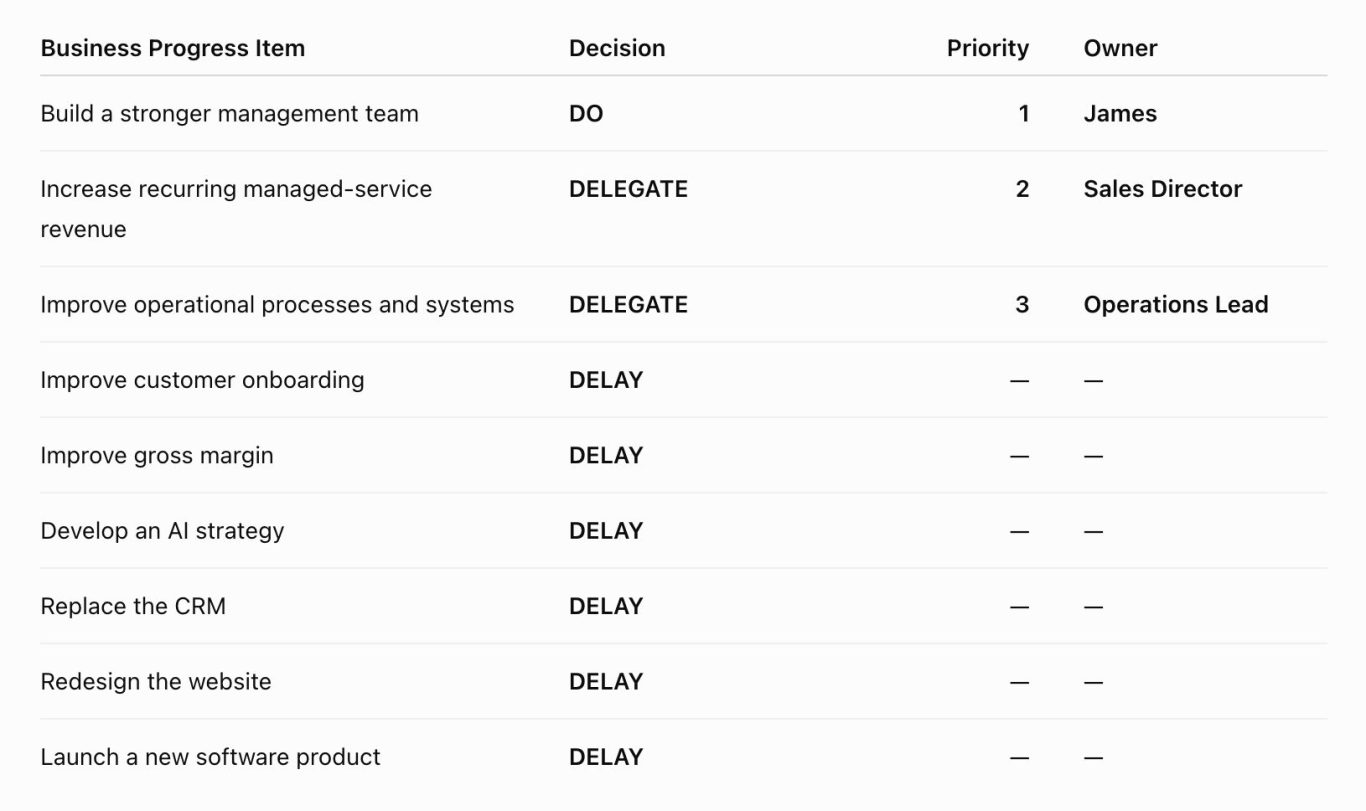
James Prioritises His Time & Attention
James now returns to his Time & Attention List from Stage 2 — Clarify.
Again, he applies the 4 Ds — but this time he's asking a different question.
Not:
“Is this important?”
But:
“Does this genuinely require my time, attention or involvement?”
James decides that some activities still genuinely require his involvement.
He chooses to DO:
- Supporting sales and key customer relationships
- Reviewing financial and business performance
- Working on business strategy
- Attending selected internal meetings
These are areas where James believes his experience, relationships and position as the business owner can still add significant value.
But much of the operational activity that has become part of his normal working week doesn't need to remain with him.
James decides to DELEGATE:
- Customer issues and escalations — to the Client Services Manager
- Employee questions — to the Department Managers
- Technical and operational problems — to the Operations Lead
- Reviewing and approving quotes and proposals — to the Sales Director
- Recruitment and people issues — to the Operations Lead
- Emails, messages and administration — to the PA / Admin Support
- Routine decisions that others regularly bring to him — to the Department Managers
- Stepping in when something isn't getting done — to the Operations Lead
Delegating these activities doesn't mean they are unimportant.
It means James doesn't need to be the person doing them.
James also recognises that some things don't need his attention right now.
He decides to DELAY exploring new business opportunities and ideas.
Opportunities will continue to arise, but James decides that actively exploring them now could distract the business from the Business Priorities and pull his own attention away from where it can make the greatest difference.
Finally, James looks at the time he spends producing a weekly management report.
When he examines why he's doing it and how the information is being used, he realises that much of it is already available elsewhere and that producing the report adds little value.
He decides to DELETE it.
James also reviews the internal meetings he attends. Rather than automatically attending every meeting, he remains involved only in those where his presence genuinely adds value.
James isn't trying to remove himself from the business.
He's deciding what genuinely requires his involvement, what someone else can own, what can wait and what no longer deserves his time.
His completed table looks like this:
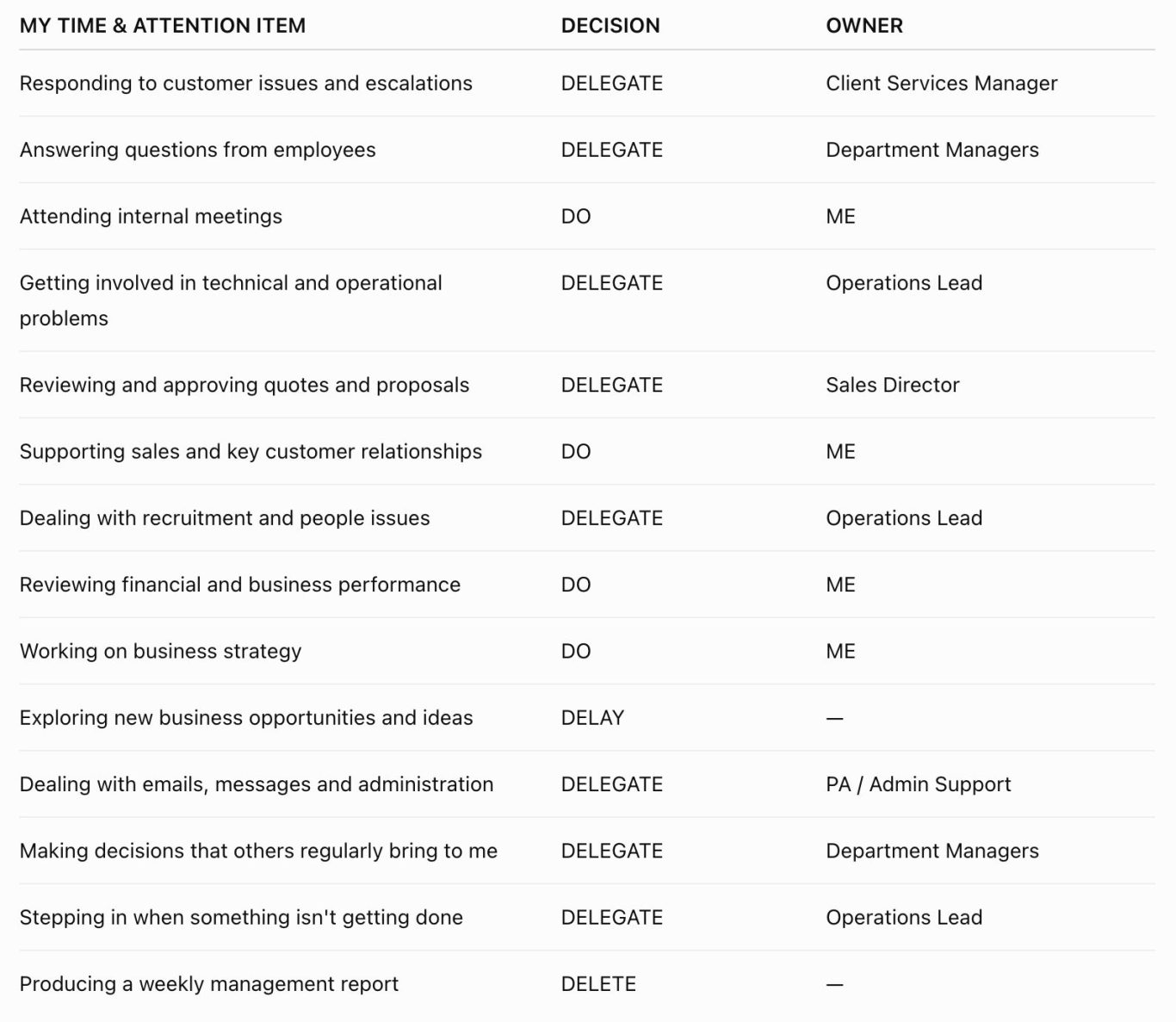
James Decides His Priority
James now brings his two completed tables together — the Business Progress List and his Time & Attention List.
The three Business Priorities from the Business Progress List are:
- Build a stronger management team — James
- Increase recurring managed-service revenue — Sales Director
- Improve operational processes and systems — Operations Lead
He also looks at the items from his Time & Attention List that he has consciously chosen to DO.
Then he returns once again to his Desired Future and asks:
“Given my Desired Future, where will my time, attention and involvement make the greatest difference?”
James considers the Business Priority he has chosen to own alongside the activities and responsibilities from his Time & Attention List that he has chosen to DO.
Increasing recurring managed-service revenue matters, but his Sales Director has clear ownership of moving it forward.
Improving operational processes and systems matters too, but his Operations Lead has clear ownership of that work.
Building a stronger management team is different.
If James is going to reduce the business's dependence on him and change his own role, he needs stronger management around him.
That requires his personal involvement.
He'll need to decide what leadership capability the business needs, strengthen the management team, establish clearer responsibilities and begin transferring meaningful ownership away from himself.
James decides:
MY PRIORITY — Build a stronger management team.
James still has other responsibilities that he has consciously chosen to DO.
Supporting sales and key customer relationships, reviewing financial and business performance, working on business strategy and attending selected internal meetings will all continue to require some of his time and attention.
But they aren't all priorities.
James has one Priority.
Rather than leaving it to whatever time remains after everything else, he will deliberately protect time for it and give it his primary focus when working on moving the business forward.
This Priority may take longer than 90 days to fully achieve.
That's okay.
The 90-day period doesn't define how long the Priority should last. It provides a timeframe for deciding what meaningful progress James wants to make towards it.
James hasn't yet decided exactly what he'll achieve or what actions he'll take.
In Stage 4 — Commit, he'll turn his Priority into a clear 90-Day Outcome, identify the Action Steps required to make it happen and decide what time he will protect to work on them.
When everything feels important, ask yourself:
“Given my Desired Future, what matters most right now?”
Then be realistic about capacity.
Just because your business could work on several things at once doesn't mean it should.
Choose the fewest Business Priorities you genuinely need — and make sure each one has a clear owner.
Then bring the focus back to you.
You may still have many responsibilities and things you've chosen to DO, but they don't all need to be priorities.
Ask yourself:
“Where will my own time, attention and involvement make the greatest difference?”
That's where your focus should go.
The business may have more than one Business Priority. You have one Priority.
Protect time for it.
If everything is a priority, nothing is.
Use your Desired Future as your filter.
Decide what deserves the business's focus, who should own it, and where your own time, attention and involvement can make the greatest difference.
Prioritisation isn't about doing everything that matters. It's about making deliberate choices about what deserves focus — and who should give it.
Now it's your turn.
Using the accompanying FOCUS FRAMEWORK Workbook, work through the following three exercises.
1. Prioritise The Business Progress List
Return to the Business Progress List you created in Stage 2 — Clarify.
Use your Desired Future as your filter and consider which items matter most in moving the business towards it.
Then consider how many Business Priorities your business can realistically make meaningful progress on at the same time.
Remember, the aim is to choose the fewest Business Priorities your business needs to focus on now. If you work on your own, I strongly recommend focusing on one. If you have a team, consider the scale and complexity of each potential priority, the people available, their existing responsibilities, and the time and resources required.
Three is the suggested maximum.
Work through each item on the Business Progress List and use the 4 Ds to decide whether you will:
- DO — This should become a Business Priority and you will personally own it.
- DELEGATE — This should become a Business Priority, but someone else will take ownership of it.
- DELAY — It may still be important, but it doesn't need attention right now.
- DELETE — It no longer deserves time, attention or resources.
For each potential Business Priority, ask yourself:
“Given my Desired Future, which of these will make the greatest difference if I get it right?”
The total number of items you mark DO or DELEGATE should not exceed the number of Business Priorities you've decided your business has the capacity to progress.
Rank the Business Priorities 1, 2 and 3, where applicable, in the PRIORITY column and identify one clear owner for each in the OWNER column.
If you choose an item to DO, you are its owner.
If you choose an item to DELEGATE, identify the person who will take ownership of it.
Everything else should be DELAYED or DELETED.
Remember, something doesn't have to be a bad idea to be delayed.
There may be several worthwhile improvements you want to make to the business. Prioritisation means deliberately deciding which deserve focus now — and which can wait.
The important thing is to choose the fewest Business Priorities your business genuinely has the capacity to progress, rank them in order of importance and give each one a clear owner.
2. Prioritise Your Time & Attention List
Now return to your Time & Attention List from Stage 2 — Clarify.
Work through each item and again apply the 4 Ds.
This time, you're deciding what should continue to require your own time, attention and involvement:
- DO — This genuinely requires my time, attention or involvement.
- DELEGATE — This still needs to happen, but someone else should take ownership of it.
- DELAY — This may still require my attention, but it doesn't need it right now.
- DELETE — This no longer deserves my time or attention.
As you work through the list, ask yourself:
“Does this genuinely require my time, attention or involvement?”
Unlike the Business Progress List, there is no fixed limit to the number of items you can choose to DO.
But that doesn't mean you should hold on to everything.
Challenge each DO before you keep it.
Ask yourself whether it genuinely requires you, whether someone else could take greater ownership, and whether you realistically have the capacity to continue giving it your time and attention.
Choosing something to DO doesn't make it a priority. It simply means you've consciously decided that it still requires your involvement.
For anything you choose to DELEGATE, identify who should take ownership in the OWNER column.
Be realistic.
The objective isn't to remove every responsibility from your plate. There will continue to be important things that genuinely require your involvement.
But the more you choose to keep, the less time and attention you'll have available for what matters most.
The objective is to retain only those responsibilities that genuinely require you — while creating enough space to focus on where your involvement can make the greatest difference.
3. Decide Your Priority
Finally, bring your two completed tables together — the Business Progress List and your Time & Attention List.
Look at the Business Priorities alongside the items you've consciously chosen to DO from your Time & Attention List.
Return to your Desired Future and ask yourself:
“Given my Desired Future, where will my time, attention and involvement make the greatest difference?”
Consider where you can add the most value — not simply what you could do yourself.
Your Priority may be one of the Business Priorities you've personally chosen to own, or it may emerge from something you've chosen to DO on your Time & Attention List.
Whichever you choose, Your Priority should support the direction you've chosen for the business — not introduce another competing Business Priority.
You may still have several responsibilities and activities you've consciously chosen to DO.
But you have one Priority.
This is where you will deliberately protect time and give your primary focus when working on moving the business forward.
Your Priority doesn't need to be achievable within 90 days.
It may remain important for several months or longer.
For now, make one deliberate choice and record it in the workbook:
MY PRIORITY:
In Stage 4 — Commit, you'll decide what meaningful progress you want to make towards Your Priority over the next 90 days, turn that into a clear 90-Day Outcome, identify the actions required and begin protecting the time needed to move it forward.
4 - COMMIT
Turn your priority into deliberate action
You've clarified your Desired Future and why it matters to you.
You've identified the Business Priorities, decided who should own them and made conscious choices about where your own time and attention should go.
Most importantly, you've identified Your Priority — where your time, attention and involvement can make the greatest difference.
Now it's time to turn that Priority into deliberate action.
A Priority isn't a plan.
And clarity, however valuable, changes very little unless it leads to action.
This is where good intentions can easily begin to fade.
You may finish your FOCUS Session feeling clear, motivated and confident about what matters.
Then the working week begins:
- Customers need attention
- Employees have questions
- Meetings fill the diary
- Emails arrive
- Problems appear
And gradually, the urgent begins to crowd out the important again.
That's why this stage is about more than deciding what to do next.
It's about turning Your Priority into a clear 90-Day Outcome, identifying the Action Steps required to achieve it and deliberately protecting the time to work on them.
Define Your 90-Day Outcome
Start by asking yourself:
“What meaningful progress do I want to make towards My Priority over the next 90 days — and what will I have achieved?”
Be as specific as you can.
Your Priority describes where you need to focus.
Your 90-Day Outcome describes what you intend to achieve as a result of that focus over the next 90 days.
Your Priority may extend well beyond those 90 days.
That's okay.
The 90-Day Outcome doesn't define how long Your Priority should last. It gives you a meaningful result to work towards during this block of focused time.
Think of your 90-Day Outcome as the next meaningful point of progress on the journey towards Your Priority.
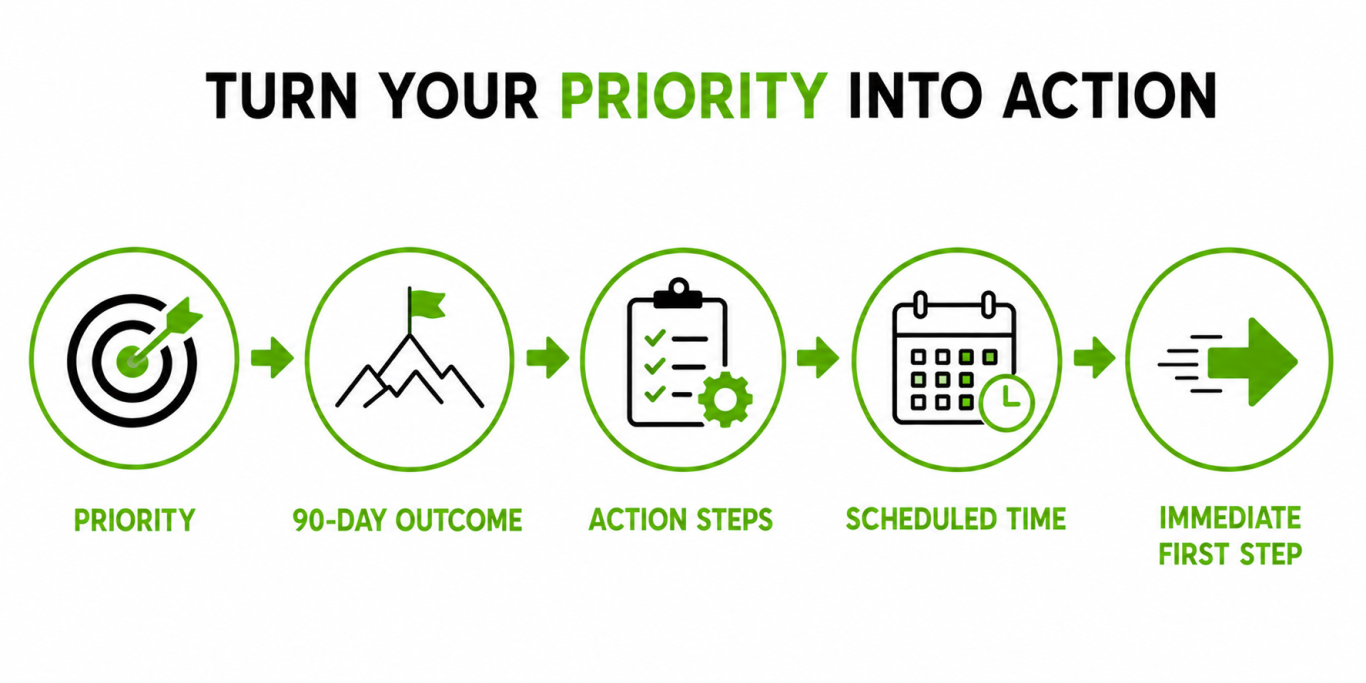
James Defines His 90-Day Outcome
James finished Stage 3 with a clear Priority:
MY PRIORITY: Build a stronger management team
That is important to the future he's trying to create, but it still doesn't tell James exactly what he intends to accomplish next.
So he asks himself:
“What meaningful progress do I want to make towards My Priority over the next 90 days — and what will I have achieved?”
James knows that one of the biggest gaps in his management team is operational leadership.
Although his Operations Lead already takes ownership of many operational issues, too many significant operational decisions and problems still find their way back to James.
He decides that meaningful progress over the next 90 days would be to strengthen the management team by recruiting someone capable of taking greater ownership of the day-to-day operation of the business and beginning to transfer responsibility to them.
His 90-Day Outcome becomes:
MY 90-DAY OUTCOME: Recruit and onboard an Operations Manager and begin transferring key operational responsibilities to them.
James isn't expecting to completely transform his management team or remove himself from operations within 90 days.
He's defined a specific, meaningful result that will move him towards his Priority and, ultimately, his Desired Future.
Identify the Action Steps
A meaningful 90-Day Outcome is unlikely to be achieved through one action.
It will usually require a series of deliberate steps.
James now asks:
“What do I need to do to achieve my 90-Day Outcome?”
He identifies the following Action Steps:
- Define the Operations Manager role and responsibilities
- Agree the salary and recruitment budget
- Write the job specification
- Engage a recruiter or advertise the position
- Review applicants
- Interview shortlisted candidates
- Make an offer
- Prepare an onboarding plan
- Identify the first operational responsibilities to transfer
- Begin handing those responsibilities over
James has now broken his 90-Day Outcome into a series of practical steps he can act on.
You don't need to create a perfect plan or anticipate every task at this stage.
Identify the key Action Steps that will move you from where you are today towards your 90-Day Outcome.
Decide What Comes First
Not every Action Step needs to happen at once.
Some will naturally depend on others being completed first.
James can't interview candidates before he's found them.
And he can't sensibly recruit an Operations Manager until he's clear about the role, responsibilities and authority that person will have.
So his first Action Step is clear:
Define the Operations Manager role and responsibilities.
Review the Action Steps you've identified and put them in a logical order.
Then ask yourself:
“What needs to happen first — and what becomes possible once that's done?”
This turns a list of actions into a sequence and helps you focus on what needs your attention next, rather than trying to move everything forward at once.
Put the Work in Your Diary
A commitment that exists only on paper is easy to lose when the working week becomes busy.
If Your Priority genuinely matters, protect time for it now.
James looks at his Action Steps and starts creating space for them in his diary.
He protects time to define the Operations Manager role, schedules time to prepare the job specification and makes space for the recruitment and interview process that will follow.
He doesn't try to schedule every minute of the next 90 days.
He creates enough structure to ensure the work required to achieve his 90-Day Outcome isn't continually pushed aside by the day-to-day demands of running the business.
Do the same with your Action Steps.
Some may need a specific deadline.
Others may require blocks of focused time in your diary.
And remember, Your Priority isn't the only thing you'll need to do.
In Stage 3 — Prioritise, you identified activities and responsibilities on your Time & Attention List that you consciously chose to DO.
Those still require appropriate time, attention or involvement.
But don't leave Your Priority to whatever time remains after everything else has been dealt with.
Protect dedicated time for the work required to achieve your 90-Day Outcome, then make appropriate space for the other responsibilities you've consciously chosen to DO.
The objective isn't to fill every available hour.
It's to make deliberate choices about where your time and attention will go — especially the work required to achieve your 90-Day Outcome.
Don't simply ask:
“When will I find time for this?”
Ask:
“What time am I going to protect for this?”
Take One Immediate Step
Finally, don't finish this process with nothing having changed.
Before you return to the rest of your working day, take one immediate action that starts moving you towards your 90-Day Outcome.
It doesn't need to be a big action.
For James, that immediate step is simple:
Block out 90 minutes in my diary to define the Operations Manager role and responsibilities.
You might:
- Make a phone call
- Send an email
- Book a meeting
- Contact a recruiter
- Arrange a conversation with a key employee
- Speak to an important customer
- Put the first block of focused time into your diary
- Make a decision you've been postponing
The size of the action matters less than the fact that you've started.
Never finish your FOCUS Session without taking one immediate step towards your 90-Day Outcome.
That first action turns your decision into movement.
Create Accountability
Decide how you'll keep yourself accountable for following through over the next 90 days.
You might share your commitment with someone you trust and ask them to become your Accountability Partner — someone who's on your side, but who will also challenge you, ask difficult questions and be honest with you about the progress you're making.
Your Accountability Partner might be a business partner, colleague, mentor, coach or someone else you trust.
James decides to share his 90-Day Outcome with his business partner and agrees that they'll check in regularly on his progress.
You don't have to have an Accountability Partner, but consider what will help you stay committed when the day-to-day demands of running the business begin competing for your attention again.
The important thing is that your commitment doesn't disappear once your FOCUS Session ends.
You've paused.
You've clarified your Desired Future and why it matters.
You've identified the Business Priorities and decided who should own them.
You've identified Your Priority — where your own time, attention and involvement can make the greatest difference.
And now you've turned Your Priority into a clear 90-Day Outcome, identified the Action Steps required and protected time to move them forward.
Commitment means knowing what you intend to achieve, what you need to do, and protecting the time to do it.
One question I regularly ask coaching clients is:
“What will you have completed before we speak again?”
It's a simple question, but it moves the conversation from intention to commitment.
It's easy to leave a conversation knowing what you should do.
It's much more powerful to decide what you will do — and then take the first step.
As you complete this stage, ask yourself:
“What can I do today to take the first step towards the outcome I've committed to?”
It doesn't need to be a big action.
It might be an email, a phone call, a conversation, a decision or simply putting protected time in your diary.
The important thing is that you don't finish your FOCUS Session with your commitment still existing only on paper.
Choose your Immediate First Step — and take it.
A Priority becomes real when you turn it into action and protect time for it.
Define your 90-Day Outcome.
Identify your Action Steps.
Decide what comes first.
Schedule and protect the time.
Take your Immediate First Step.
And create the accountability that will help you follow through.
You've identified Your Priority.
Now it's time to decide what meaningful progress you want to make towards it over the next 90 days — and turn that into deliberate action.
Using the accompanying workbook:
1. Define Your 90-Day Outcome
Return to Your Priority from Stage 3 — Prioritise.
Ask yourself:
“What meaningful progress do I want to make towards My Priority over the next 90 days — and what will I have achieved?”
Be specific about what you want to have changed, completed or achieved by the end of the 90 days.
Remember, Your Priority may extend beyond the next 90 days. Your 90-Day Outcome defines the meaningful result you want to achieve during this block of focus.
Record this in MY 90-DAY OUTCOME in the workbook.
2. Identify and Prioritise Your Action Steps
Ask yourself:
“What do I need to do to achieve my 90-Day Outcome?”
Using the Action Steps table in the workbook, identify the key actions required.
Then put them in a logical order.
Ask yourself:
“What needs to happen first — and what becomes possible once that's done?”
Consider which actions depend on others and what needs to be completed along the way.
Don't worry about creating the perfect plan or anticipating every task.
The objective is to create a clear route from where you are today to the 90-Day Outcome you've committed to achieving.
3. Schedule and Protect the Time
Now protect the time required to make it happen.
Review your Action Steps and decide when you'll work on them.
Put important deadlines, meetings and focused work into your diary.
Where an Action Step requires sustained work rather than a single deadline, schedule dedicated blocks of focused time for it.
Then return to your Time & Attention List from Stage 3 — Prioritise and look specifically at the items you chose to DO.
These are the activities and responsibilities you've consciously decided still require your time, attention or involvement.
Ask yourself:
“Have I protected enough time for the work required to achieve my 90-Day Outcome, while still allowing appropriate time for the other responsibilities I've chosen to DO?”
Make sure you've considered:
- The Action Steps and focused work required to achieve your 90-Day Outcome
- The ongoing responsibilities from your Time & Attention List that you've chosen to DO
- Any important deadlines, meetings or commitments associated with either
You don't need to schedule every minute of the next 90 days.
But don't leave Your Priority to whatever time remains after everything else has been dealt with.
Protect dedicated time for the work required to achieve your 90-Day Outcome, then make appropriate space for the other responsibilities you've consciously chosen to DO.
The objective is to create enough structure so the things you've deliberately decided deserve your attention have space — especially the work required to achieve your 90-Day Outcome.
Don't rely on finding spare time.
Make the time visible in your diary.
4. Take One Immediate Step
Before you finish your FOCUS Session, take one action that starts moving you towards your 90-Day Outcome.
Ask yourself:
“What can I do right now — or before the end of today — to begin moving this forward?”
It doesn't need to be a big action.
Make the call. Send the email. Book the meeting. Contact the person. Schedule the first block of focused time.
Record MY IMMEDIATE FIRST STEP in the workbook and decide WHEN you'll take it — ideally now, or before the end of today.
Then do it.
5. Create Accountability
Finally, decide how you'll keep yourself accountable for following through over the next 90 days.
Ask yourself:
“How will I make sure I continue to act on what I've committed to?”
You don't have to have an Accountability Partner, but consider what will help you stay committed when the day-to-day demands of running the business begin competing for your attention again.
If having an Accountability Partner would help, decide who you will ask and how often you'll check in with them about your progress.
Choose someone who's on your side, but who you can trust to challenge you and be honest with you when needed.
If you choose to use an Accountability Partner, record your commitment in the workbook:
- I WILL BE ACCOUNTABLE TO:
- I WILL CHECK IN WITH MY ACCOUNTABILITY PARTNER:
5 - PROTECT
Protect what matters most
You've created the space to think.
You've clarified your Desired Future and why it matters to you.
You've decided what matters most and identified Your Priority — where your own time, attention and involvement can make the greatest difference.
In Stage 4 — Commit, you turned that Priority into deliberate action.
You defined a 90-Day Outcome, identified the Action Steps required to achieve it and protected time in your diary to make progress.
Now comes a different challenge.
Protecting that commitment.
Because once the day-to-day demands of running your business return:
- Customers will make unexpected requests
- Employees will need your support
- Problems will appear
- New opportunities will emerge
- Meetings will be requested
- Emails will arrive
Some of these things will genuinely require your attention.
The challenge isn't to eliminate interruption or pretend that nothing unexpected will happen.
It's to prevent the focus you've deliberately created from gradually being consumed by everything else.
How It All Fits Together
Your 90-Day Outcome gives you a meaningful result to work towards during this block of focus.
That outcome moves you towards Your Priority.
And Your Priority helps move you towards your Desired Future.
At the end of the 90 days — or earlier if circumstances meaningfully change — you'll step back and review your progress.
Your Priority may still be the right Priority. If it is, you'll decide what meaningful progress should look like during the next period of focus.
Or you may decide that circumstances have changed and something else now deserves your focus.
The purpose of the review isn't to change Your Priority automatically. It's to make a conscious decision about what deserves your focus next.
But first, you need to protect the commitments you've already made.
The FOCUS Cycle
Your first FOCUS Session helps you decide what matters most and turn that clarity into action.
But maintaining focus isn't a one-off exercise.
The FOCUS Cycle shows how Your Priority connects to the actions you take, the time you protect and the regular reviews that help you stay focused as circumstances change.
Your Desired Future provides the direction.
Your Priority identifies where your own time, attention and involvement can make the greatest difference.
Your 90-Day Outcome defines the meaningful progress you want to make during the current period of focus.
Your Action Steps turn that outcome into practical action, supported by Scheduled & Protected Time in your diary.
Your Weekly FOCUS Review helps you stay on track.
And at your 90-Day FOCUS Review, you step back and consider what you've achieved and whether Your Priority is still the right one.
If it is, you continue with it and define the next meaningful outcome.
If it isn't, you consciously decide what Your Priority should be next.
The objective isn't to keep changing your Priority. It's to keep making deliberate choices about where your focus will make the greatest difference.
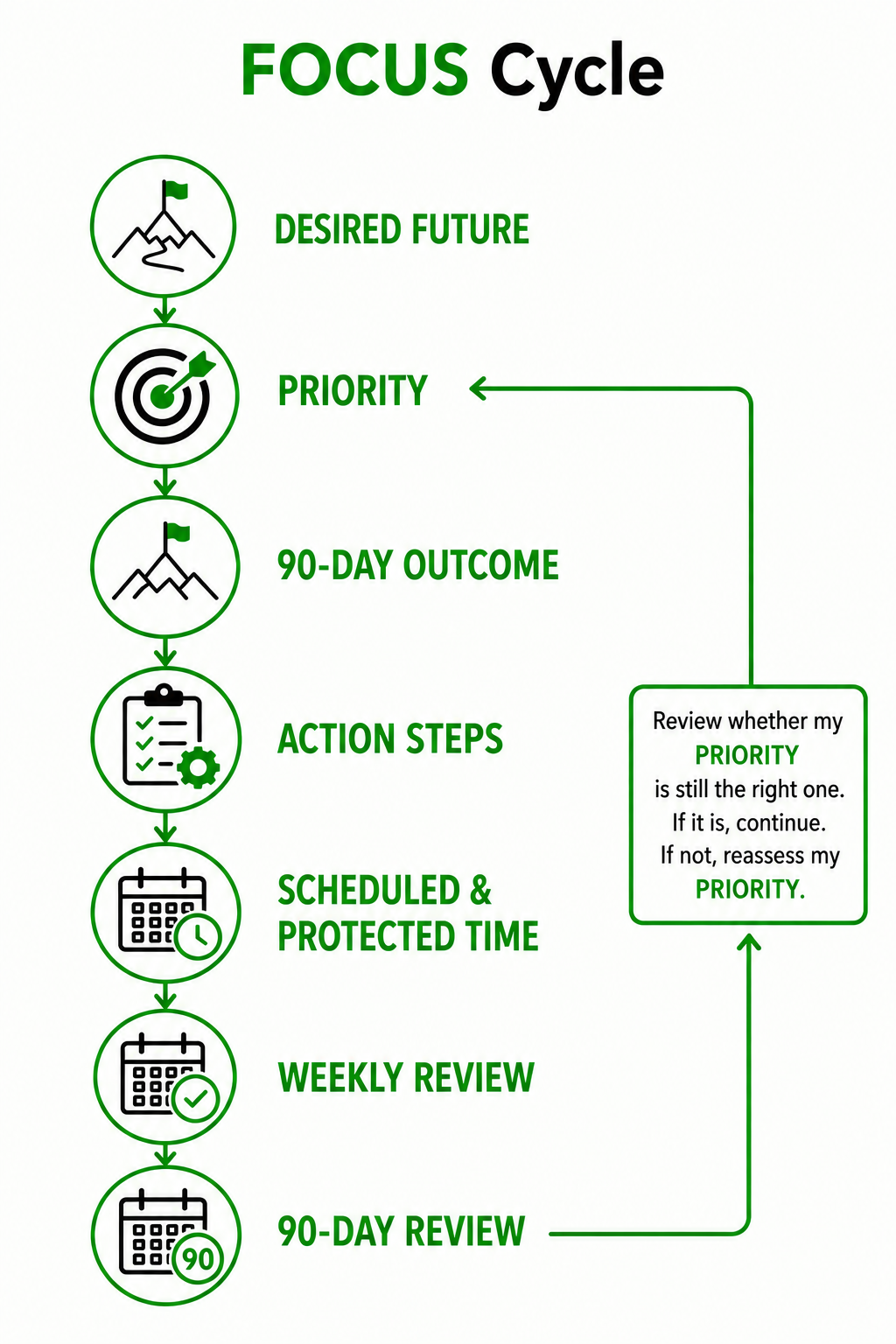
Protect the Time You've Committed
In Stage 4 — Commit, you deliberately protected time for the Action Steps required to achieve your 90-Day Outcome.
You also considered the responsibilities on your Time & Attention List that you chose to DO and how they need to fit into your working week.
Treat the time you've protected as a commitment.
Of course, genuine emergencies and important changes will sometimes require you to adjust your plans.
But don't allow every request, meeting, problem or new idea to automatically displace the work you've already decided matters.
Before giving away time you've protected, ask yourself:
“Is this genuinely more important than what I've already committed to?”
If it is, make a conscious decision to change your plan — and, where possible, reschedule the protected time rather than simply losing it.
If it isn't, protect the time.
James Protects His Time
James has committed to recruiting and onboarding an Operations Manager and beginning to transfer key operational responsibilities to them.
He's already protected time in his diary to work on the recruitment process.
A few days later, someone asks him to attend an internal meeting during one of those blocks.
Previously, James might simply have accepted the meeting and moved his focused work somewhere else — or allowed it to disappear altogether.
This time, he stops and asks:
“Is this genuinely more important than what I've already committed to?”
He decides that his presence isn't essential and asks the Operations Lead to attend instead.
The protected time stays in his diary.
It's a small decision.
But those small decisions are how James prevents the work required to achieve his 90-Day Outcome from gradually being pushed aside.
Protect Your Attention
Your diary isn't the only thing that needs protecting.
So does your attention.
A two-hour block in your calendar won't help if it's constantly interrupted by emails, messages, phone calls and people asking for decisions.
When you're working on the Action Steps required to achieve your 90-Day Outcome, create the conditions that allow you to focus.
That might mean:
- Closing email and messaging apps
- Putting your phone on silent
- Declining unnecessary meetings
- Letting your team know when you're unavailable
- Working somewhere you won't be interrupted
- Creating clear boundaries around focused work
James recognises that simply putting time in his diary isn't enough.
During his protected focus blocks, he closes his email and messaging apps, puts his phone on silent and lets his team know that he's unavailable unless something genuinely requires his immediate attention.
The objective isn't to remove yourself from the business.
It's to make sure the work you've deliberately chosen receives enough uninterrupted attention to make meaningful progress.
Be Careful What You Say Yes To
New ideas and opportunities won't stop appearing simply because you've completed the FOCUS FRAMEWORK.
Some may be excellent.
But every new commitment competes for the same limited time, attention and resources.
Before saying yes, return to your Desired Future and the commitments you've already made.
Ask yourself:
“Given my Desired Future and the commitments I've already made, does this deserve my attention now?”
A good opportunity at the wrong time can still be a distraction.
You don't necessarily need to reject it.
You can DELAY it.
Capture it, return to it later and make the decision deliberately rather than allowing it to derail what you've already committed to.
James Protects His Priority
A few weeks into his 90-day block, James is presented with an opportunity to explore a new software product.
It's interesting — and exactly the kind of opportunity that would previously have pulled his attention in a new direction.
But James has already considered this idea during Stage 3 — Prioritise and chosen to DELAY it.
So rather than reopening the decision simply because the opportunity has appeared again, he captures the new information and decides to reconsider it at a future review.
He hasn't decided it's a bad idea.
He's decided it's not where the business's focus belongs right now.
Review Your Progress Regularly
Protecting your focus doesn't mean blindly following a plan for 90 days regardless of what happens.
Things change. The business changes. New information becomes available.
Something that seemed important may become less important — or a genuinely significant issue or opportunity may emerge.
That's why regular review matters.
Set aside a short Weekly FOCUS Review to reconnect with the decisions you've made and review your progress.
Your Weekly FOCUS Review contains a concise set of questions to help you review your progress, protect your focus and make any necessary adjustments.
One of the key questions in your Weekly FOCUS Review is:
“Am I still giving My Priority the time and attention it deserves?”
Review:
- Your 90-Day Outcome
- Your Action Steps
- The time you've protected
- The Business Priorities and who owns them
- The items on your Time & Attention List you've chosen to DO
- Anything new that's competing for your attention
Then decide whether anything needs to change.
You may need to adjust an Action Step. You may need to reschedule some protected time.
You may realise something you chose to DO should now move to DELEGATE. Or circumstances may genuinely have changed enough to require you to reconsider a decision.
That's okay.
The important thing is that you make those changes deliberately, rather than allowing the latest urgent demand to determine where your attention goes.
James Reviews His Focus
Every Friday afternoon, James sets aside 20 minutes to review his progress.
He checks whether he's making meaningful progress towards his 90-Day Outcome, whether he's protected the time he committed to his Action Steps, and whether anything new has begun consuming his attention.
He also looks back at the activities and responsibilities on his Time & Attention List and checks whether the choices he made in Stage 3 are still holding.
If something he chose to DELEGATE is beginning to drift back onto his plate, he notices it and makes a conscious decision about what to do with it.
The Weekly FOCUS Review helps James correct small drifts before they become a loss of focus.
Review at 90 Days
At the end of your 90-day block, step back again.
This time, conduct your 90-Day FOCUS Review.
Your 90-Day FOCUS Review contains a more detailed set of questions to help you review what you've achieved, what you've learned and decide deliberately where your focus should go next.
Review the outcome you committed to and the progress you've made.
Some of the key questions in your 90-Day FOCUS Review are:
“Did I achieve the outcome I set?”
“What progress have I made towards My Priority?”
“What have I learned?”
Then return to the bigger question:
“Is this still where my time, attention and involvement will make the greatest difference?”
If Your Priority remains the right one, define your next meaningful 90-Day Outcome and continue moving forward.
If Your Priority has been completed, or circumstances have genuinely changed, return to your Desired Future and use what you've learned to decide where your focus should go next.
The objective isn't to keep following an old decision simply because you made it.
It's to remain deliberate about where your time and attention go.
What If You Complete Your 90-Day Outcome Early?
You don't need to wait until the end of the 90 days to review your focus.
If you achieve your 90-Day Outcome early, bring your 90-Day FOCUS Review forward.
Review what you've achieved and what you've learned, then ask yourself:
“Is My Priority still where my time, attention and involvement will make the greatest difference?”
If it is, define your next meaningful 90-Day Outcome and continue moving forward.
If you've completed Your Priority — or it no longer deserves your focus — return to your Desired Future and use it as your filter to decide what matters most next.
Then choose Your Priority deliberately.
The 90-day block gives you a period of focused action. It isn't a reason to wait when you're ready to move forward.
James Reaches His 90-Day Review
At the end of his 90-day block, James returns to the 90-Day Outcome he committed to:
Recruit and onboard an Operations Manager and begin transferring key operational responsibilities to them.
He reviews what he's achieved, what he's learned and the progress he's made towards building a stronger management team.
Then he asks himself:
“Is building a stronger management team still where my time, attention and involvement will make the greatest difference?”
If the answer is yes, James doesn't need a new Priority simply because 90 days have passed.
He defines his next 90-Day Outcome and continues.
If he's achieved what he needed from that Priority — or circumstances have genuinely changed — he returns to his Desired Future and uses what he's learned to decide where his focus should go next.
The 90-Day FOCUS Review isn't an automatic reset. It's a deliberate decision point.
This is what keeps the FOCUS Cycle moving — review, learn, then consciously decide where your focus belongs next.
Protect the Thinking Behind Your Decisions
Once you have completed your FOCUS FRAMEWORK Workbook, keep it somewhere accessible.
It contains more than a list of tasks.
It captures the thinking that helped you decide:
- Where you want to go — your Desired Future
- Why that future matters to you — your Motivation
- What the business needs to focus on — the Business Priorities
- Where your own time, attention and involvement can make the greatest difference — Your Priority
- What you've consciously chosen to DO, DELEGATE, DELAY or DELETE
At the end of the FOCUS FRAMEWORK, you'll bring the key decisions you've made together in My FOCUS Plan.
Use your FOCUS Plan as the concise summary you return to throughout your 90-day focus block.
It keeps the decisions that matter most visible without requiring you to revisit the entire workbook.
When you need to reconnect with the thinking behind a decision, return to the relevant section of your completed workbook.
Together, your FOCUS Plan and your completed FOCUS FRAMEWORK Workbook help you stay connected not only to what you decided, but why you decided it.
Focus isn't something you find once.
It's something you choose — and then continue to protect.
One of the most useful questions you can ask yourself each week is:
“Is the way I've spent my time this week consistent with what I said matters most?”
It's easy to start the week with good intentions and still find that your time has been consumed by other people's priorities, unexpected problems and the usual day-to-day demands of running the business.
If the answer is broadly yes, keep going.
If the answer is no, don't simply work harder or try to squeeze more into the following week.
Look at what pulled your time and attention away.
Then ask yourself:
“What needs to change next week?”
You may need to protect your diary more carefully, delegate something you've taken back, say no to a meeting or create better boundaries around your focused work.
The aim isn't to have a perfect week. It's to notice when your focus is drifting — and deliberately bring it back.
Protect the focus you've created from being gradually replaced by urgency, distraction and new demands.
Protect your time.
Protect your attention.
Notice when your focus starts to drift.
Review your progress regularly.
And when circumstances genuinely change, change direction deliberately.
You've decided what matters most, defined your 90-Day Outcome and protected time to take action.
Before you finish your FOCUS Session, put some simple safeguards in place to help protect that focus over the next 90 days.
1. Identify What Could Pull You Off Course
Think about your normal working week.
What is most likely to interrupt, distract or pull your time and attention away from Your Priority and the Action Steps you've committed to?
Consider things such as:
- Customer escalations
- Employee questions
- Meetings
- Email and messaging
- Operational problems
- New opportunities
- Your own habits
- Taking back work you've delegated
- Saying yes too quickly
Be honest about the things that most often compete for your attention.
In the workbook, complete:
THE BIGGEST RISKS TO MY FOCUS ARE:
2. Decide How You'll Protect Your Focus
Now consider the risks you've identified.
Ask yourself:
“What can I put in place to prevent these things from repeatedly pulling me away from what matters most?”
You might need to create clearer boundaries, change a habit, communicate differently with your team, decline unnecessary meetings, switch off notifications or become more deliberate about what you agree to.
In the workbook, complete:
TO PROTECT MY FOCUS, I WILL:
3. Protect the Time in Your Diary
In Stage 4 — Commit, you deliberately protected time for the Action Steps required to achieve your 90-Day Outcome.
Now decide how you'll protect that time when the day-to-day demands of the business compete for it.
Ask yourself:
“What do I need to put in place to protect the time I've committed to my Action Steps?”
Think about what could cause you to give that time away — and what boundaries or practical changes will help you keep it protected.
And remember: if something genuinely more important requires you to change your plans, reschedule the protected time rather than simply losing it.
In the workbook, complete:
I WILL PROTECT THIS TIME BY:
4. Schedule Your Weekly FOCUS Review
Choose a regular time each week to reconnect with the decisions you've made and review your progress.
This doesn't need to take long.
Once you've practised the review a few times, around 20 minutes should usually be enough.
You might, for example, make it part of your Monday morning routine — grab a drink, step away from the day-to-day and complete your Weekly FOCUS Review before the week gets underway.
During your review, use your FOCUS Plan to reconnect with the decisions you've made and work through the questions in your Weekly FOCUS Review to check your progress, protect your focus and make any necessary adjustments.
Now schedule your regular Weekly FOCUS Review in your diary.
5. Schedule Your 90-Day FOCUS Review
Put a review date in your diary for the end of your 90-day block.
Your 90-Day FOCUS Review gives you the opportunity to step back, review what you've achieved and learned, and decide deliberately where your focus should go next.
During your review, use your FOCUS Plan to reconnect with the decisions you've made and work through the questions in your 90-Day FOCUS Review.
If Your Priority is still the right one, you'll define your next 90-Day Outcome and continue moving forward.
If Your Priority has been completed — or circumstances have genuinely changed — you'll return to your Desired Future and use what you've learned to decide where your focus should go next.
The purpose of the review isn't to change Your Priority automatically. It's to make a deliberate decision about what deserves your focus next.
Now schedule your 90-Day FOCUS Review in your diary.
BRINGING IT ALL TOGETHER
By now, you've worked through each stage of the New Perspectives FOCUS FRAMEWORK and applied it to yourself and your business.
Although each stage has its own purpose, the real power of the framework comes from using them together.
You PAUSED — creating the time and space to step back from the day-to-day demands of running your business.
You CLARIFIED — where you are today, your Desired Future, why achieving it matters to you, what needs to change and where your time and attention are currently going.
You PRIORITISED — deciding what matters most for the business, what deserves your own attention and what you can DO, DELEGATE, DELAY or DELETE.
You COMMITTED — turning Your Priority into a clear 90-Day Outcome, identifying the Action Steps required and protecting time to make meaningful progress.
And finally, you PROTECTED — putting safeguards and regular reviews in place to help prevent your focus from being gradually consumed by the day-to-day demands of running your business.
You should now have something far more valuable than another list of things to do.
You have greater clarity about the future you're trying to create — your Desired Future.
You understand why achieving it matters to you — your Motivation.
You know what matters most for the business — the Business Priorities.
You know where your own time, attention and involvement can make the greatest difference — Your Priority.
And you have a clear 90-day block of focused action to start making meaningful progress towards it.
The Framework Doesn't End Here
Your business will continue to evolve.
New opportunities will appear.
New challenges will emerge.
Your circumstances — and perhaps what you want from the business — will change.
That's why the FOCUS FRAMEWORK isn't something to complete once and forget.
At the end of your 90-day block — or earlier if you achieve your 90-Day Outcome or complete Your Priority sooner — step back and conduct your 90-Day FOCUS Review.
If Your Priority is still where your time, attention and involvement can make the greatest difference, define your next 90-Day Outcome and continue moving forward.
If Your Priority has been completed — or circumstances have genuinely changed — return to your Desired Future from Stage 2 — Clarify.
Ask yourself whether it still reflects the future you want to create.
If it does, use it as your filter and return to Stage 3 — Prioritise to decide what deserves the business's focus and where your own time, attention and involvement can make the greatest difference.
If your Desired Future has changed, return to Stage 2 — Clarify and clarify it again before deciding what matters most.
This is the FOCUS Cycle in action — review, learn and consciously decide where your focus belongs next.
And whenever you find yourself overwhelmed, reacting to everything around you or uncertain about what matters most, return to the framework.
PAUSE — CLARIFY — PRIORITISE — COMMIT — PROTECT
Then move forward again with greater clarity and intention.
FOCUS FRAMEWORK Overview
Here's how the five stages work together to take you from stepping back and gaining clarity to taking action and protecting your focus:
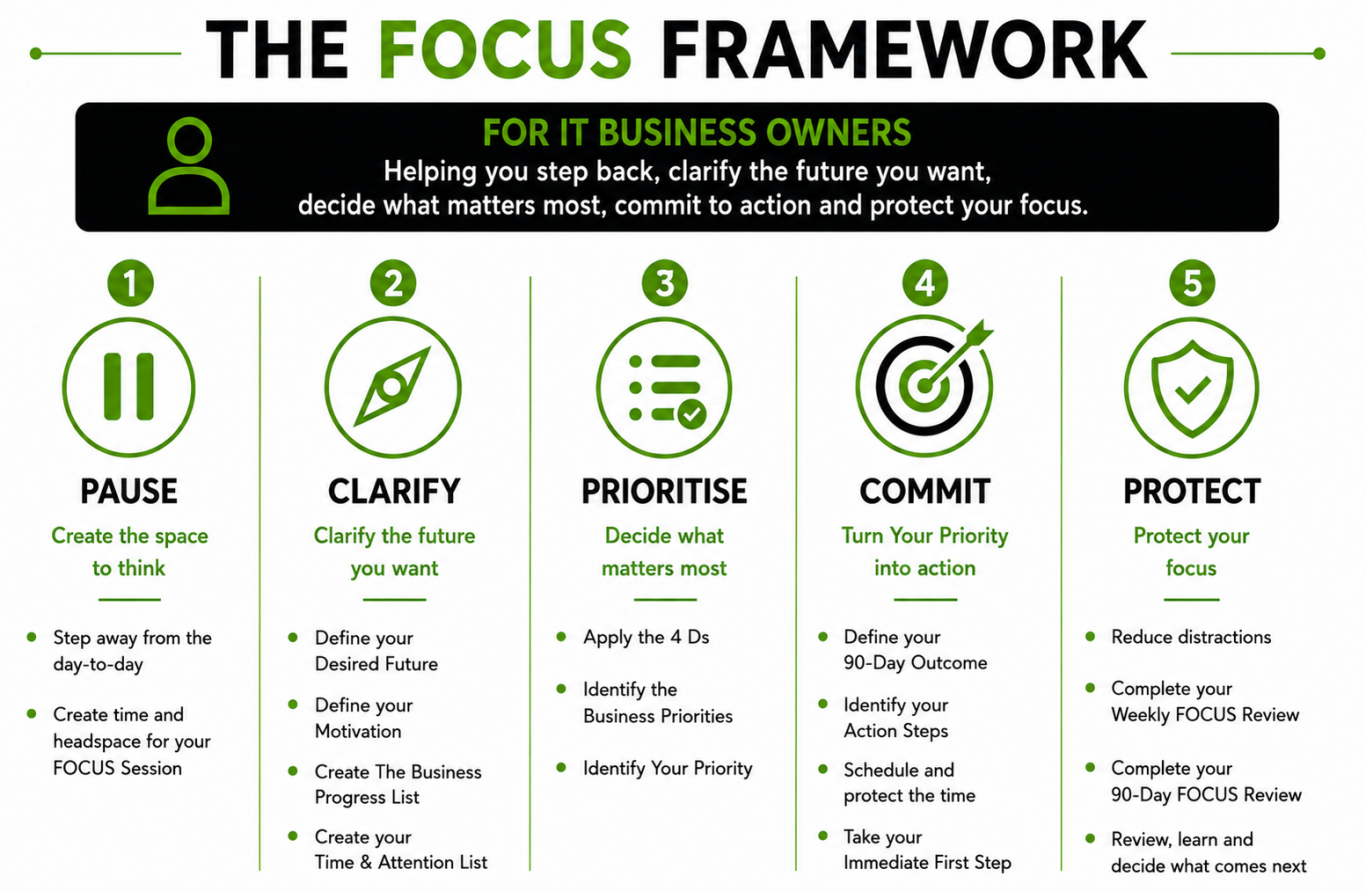
MY FOCUS PLAN
You've done the thinking.
Now bring your most important decisions together in one place.
At the end of the FOCUS FRAMEWORK Workbook, you'll find your FOCUS Plan — designed to bring together the key decisions you've made throughout the framework and keep them visible as you put them into action.
MY FOCUS PLAN
Your FOCUS Plan isn't another exercise.
It brings together the key decisions you've already made throughout the FOCUS FRAMEWORK.
Once you've completed the workbook, TRANSFER the following into your FOCUS Plan:
- Your Desired Future — copy this from Stage 2 — Clarify
- Your Motivation — copy this from Stage 2 — Clarify
- The Business Priorities and who owns them — copy these from Stage 3 — Prioritise
- Your Priority — copy this from Stage 3 — Prioritise
- Your 90-Day Outcome — copy this from Stage 4 — Commit
- Your Action Steps — copy these from Stage 4 — Commit
- The other responsibilities you've chosen to DO — copy these from your Time & Attention List in Stage 3 — Prioritise
You don't need to rethink or recreate anything here. Simply transfer the final decisions you've already made into your FOCUS Plan.
This gives you one clear, practical summary of where you're going, what matters most and what you've committed to doing next.
Keep your FOCUS Plan somewhere accessible and use it as the starting point for your Weekly FOCUS Review and 90-Day FOCUS Review.
Rather than returning to every exercise in the workbook, your FOCUS Plan gives you a quick way to reconnect with the key decisions you've made, the progress you're working towards and the commitments you've made.
MY FOCUS REVIEWS
Your FOCUS Reviews provide the structure for:
- Your Weekly FOCUS Review
- Your 90-Day FOCUS Review
They contain the review questions you'll use to work through your Weekly FOCUS Review and 90-Day FOCUS Review, helping you assess your progress, protect your focus and make deliberate adjustments when needed.
The workbook helps you do the thinking.
Your FOCUS Plan keeps that thinking visible.
Your FOCUS Reviews help you stay connected to it and make deliberate adjustments as circumstances change.
Use your FOCUS Plan as the concise summary you return to throughout your 90-day focus block, and use your FOCUS Reviews to help you stay connected to the decisions you've made.
MY FOCUS PLAN & MY FOCUS REVIEWS
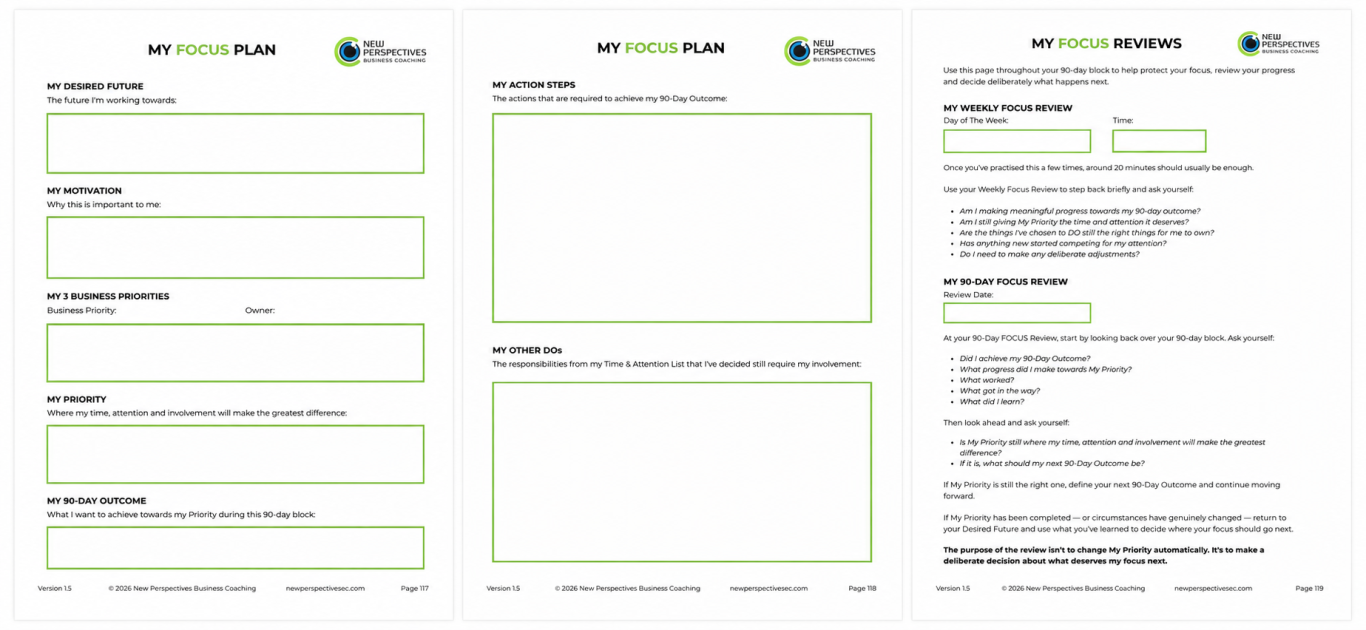
Now It's Over to You
You've done the thinking.
You've made the decisions.
You've identified what matters most.
Now protect your focus and put those decisions into action.
CONTINUE YOUR JOURNEY
The New Perspectives FOCUS FRAMEWORK has given you a practical process for stepping back, thinking clearly and deciding where your time, attention and involvement can make the greatest difference.
You can continue to use the framework independently whenever you need to regain clarity and refocus.
But sometimes it helps to have someone alongside you.
Someone who can give you the space to think, challenge your assumptions, ask the questions you may not ask yourself and help you remain accountable for the decisions and commitments you make.
If you'd value that support, I'd be delighted to help.
Through New Perspectives BUSINESS MOMENTUM, my one-to-one coaching programme, we'll build on the thinking you've started here and focus on the priorities, opportunities and challenges that matter most to you and your business.
Depending on what you want to achieve, our coaching conversations might explore areas such as your leadership, strategy, team, systems, growth, profitability or the longer-term future of the business.
But the objective remains the same:
To help you build a better business while creating a better life for yourself as its owner.
If you'd like to explore whether the Business Momentum Coaching Programme could help you put this thinking into practice and move your business forward, you're welcome to schedule a complimentary Discovery Call.
There's no obligation and no sales pressure.
It's simply an opportunity to step away from the day-to-day, gain greater clarity and insight into where you are today, where you'd like to get to and what may be getting in the way. We'll also explore whether we're a good fit to work together.
If you'd like to continue the conversation, click the button below to schedule your complimentary Discovery Call:
Whatever your next step, I wish you every success.
I hope the New Perspectives FOCUS FRAMEWORK helps you continue building not only a better business — but a better life.
Kevin Thomas
Founder & Coach
New Perspectives Business Coaching
© 2026 New Perspectives Business Coaching. All rights reserved.