
Building an Exit-Ready IT Business: The Power of 90-Day Momentum
Preparing your IT business for a potential future exit often starts with taking a step back and asking yourself a few important questions
Where is the business today?
Where would you like it to be in the future?
What might need to change to put you in a better position for a potential exit?
These are important questions, and taking the time to answer them can help bring some much-needed clarity and direction. But understanding what needs to change and creating a plan is only the beginning. The real challenge is making progress while continuing to deal with the day-to-day demands of running a business.
Whether you run a managed service provider (MSP), software company, cybersecurity business, IT consultancy, hardware and systems integration business, or another type of IT services company, many of the challenges are similar.
Reducing owner dependency, developing a stronger management team, building more predictable revenue and creating a business that can grow without your constant involvement are all areas that may need attention.
And of course, there's still the day-to-day business to run. Customers need attention, people issues arise, new opportunities appear and sometimes things simply take longer than expected.
Before you know it, several months have passed and some of those important priorities you identified have taken a back seat.
This is where maintaining momentum becomes so important.
For an IT business owner considering a potential future exit, building a stronger, less owner-dependent and more exit-ready business is unlikely to happen overnight. It takes time, focus and a willingness to keep reviewing what matters most as the business develops.
Introducing the Momentum Framework
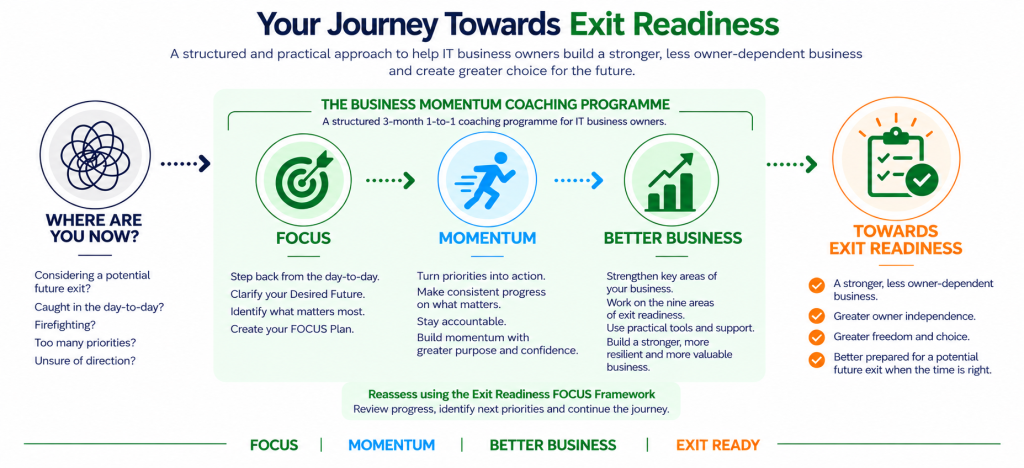
The Momentum Framework forms an important part of my Business Momentum Coaching Programme, which is designed to help IT business owners prepare themselves and their business for a potential future exit.
It acts as a bridge between two other key components of the programme: the Exit Readiness FOCUS Framework and the Better Business Framework.
The idea is to provide a connected approach that helps business owners understand where they are today, decide what matters most and continue making progress towards building a stronger, more exit-ready business.
How the Three Frameworks Work Together
1. Exit Readiness FOCUS Framework
The starting point is the Exit Readiness FOCUS Framework, which helps you step back from the day-to-day demands of running your business and think about where you are today and where you'd like to be in the future.
It encourages you to consider your Desired Future, assess nine important areas of your business and identify the Business Priorities that deserve your attention.
From there, you decide where your own time and energy could make the greatest difference and bring everything together into a practical FOCUS Plan, including your first 90-Day Outcome.
2. Momentum Framework
Once you've established your priorities and created your FOCUS Plan, the next challenge is putting that plan into action and maintaining progress.
This is where the Momentum Framework comes in.
Rather than creating another plan, Momentum helps you work with your existing FOCUS Plan, establish a regular rhythm of action and review, and continue making progress through successive 90-day blocks.
It provides a way of stepping back at regular intervals, recognising what's been achieved, learning from what's happened and deciding where to focus next.
3. Better Business Framework
As you work through your priorities, you may identify areas of the business that would benefit from deeper attention.
The Better Business Framework provides nine practical learning and coaching modules, each corresponding to one of the nine Exit Readiness Assessment areas.
The modules explore relevant business practices, common challenges and some of the things potential buyers typically look for when assessing a business.
They're designed to support learning, reflection and coaching conversations, helping you consider different approaches and decide what improvements, if any, make sense for your business.
Importantly, the modules aren't intended to be completed in a particular order. They're used when they become relevant to a Business Priority or challenge, including during successive 90-day blocks.
Together, the three frameworks provide a connected approach:
FOCUS helps you identify what matters. MOMENTUM helps you keep moving. BETTER BUSINESS helps you strengthen the areas that need attention.
The overall aim is to help you build a stronger, less owner-dependent business and put yourself in a better position to explore a potential future exit when the time is right for you.
The First 90 Days Are Only the Beginning
One of the approaches I use in my business coaching is to encourage owners to think in 90-day blocks.
I like this approach because 90 days is generally long enough to make meaningful progress, while being short enough to maintain focus and adapt when circumstances change.
For example, your first 90-day block might involve strengthening your management team, improving financial reporting or beginning to reduce your involvement in day-to-day operational decisions.
But what happens at the end of those first 90 days?
Rather than simply creating another list of things to do, I think it's important to take some time to reflect on what's actually happened. What progress have you made? What worked well? What didn't go quite as planned? And what have you learned about yourself and your business along the way?
It's also an opportunity to revisit your wider Business Priorities and consider whether they still reflect what the business needs.
Perhaps you've made good progress and can continue building on what you've started. Maybe something has taken longer than expected, or a new challenge has emerged that deserves attention.
The important thing is to use what you've learned to decide where to focus next, rather than simply carrying on with the original plan because that's what you set out to do.
Focus, Act, Review and Refocus
At the heart of my Momentum Framework is a simple approach:
FOCUS → ACT → REVIEW → REFOCUS
It starts with being clear about what matters most and deciding where to direct your attention. You then take action, review the progress you've made and use what you've learned to decide what happens next.
Sometimes that will mean continuing with the same priority for another 90-day block. In other cases, you may have achieved what you set out to do, allowing that area to become part of the normal running of the business.
And occasionally, something unexpected may happen that changes your priorities altogether.
That's perfectly normal. Businesses don't operate in a straight line, and neither does the process of preparing one for a potential future exit.
For me, maintaining momentum isn't about rigidly following a plan regardless of what happens around you. It's about keeping sight of where you want to go, making progress and being prepared to adjust your approach when necessary.
You Don't Have to Personally Drive Everything
One of the things I learned from my own experience of building and eventually selling an IT business was the importance of developing a team that could take responsibility and make decisions without everything coming back to me.
It's easy as a business owner to become involved in almost every aspect of the business, particularly when you've helped build it from the ground up. You know the customers, understand the systems and have probably spent years being the person everyone turns to when something needs sorting out.
But if you're preparing for a potential future exit, it's worth asking whether that level of involvement is helping the business or holding it back.
You may have several Business Priorities that need attention, but that doesn't mean you should personally be responsible for delivering every one of them.
For example, your Sales Director might take responsibility for increasing recurring revenue, while an Operations Manager focuses on improving processes and documentation. Other members of the team may be better placed to lead improvements in their own areas.
As the owner, your role becomes increasingly about looking at the business as a whole, agreeing where improvements are needed, ensuring the right people take responsibility and deciding where your own time and attention can make the greatest difference.
That's an important distinction. You can remain responsible for the overall direction of the business without personally driving every improvement.
I've explored this subject in more detail in my article, How to Reduce Owner Dependency Before Selling Your IT Business.
Exit Readiness Isn't a Nine-Point To-Do List
Within my Exit Readiness FOCUS Framework, I encourage IT business owners to step back and assess nine important areas of their business.
These areas provide a useful starting point for understanding where the business is today and where improvements might help strengthen its position ahead of a potential future exit.
The nine Exit Readiness Assessment areas are:
- Owner Dependency — Can the business run without you?
- People & Structure — Do you have the right people and structure?
- Predictable Revenue — How predictable is your revenue?
- Customer Base — How strong is your customer base?
- Sustainable Growth — Can the business keep growing without you?
- Financial Reporting — Do you really know your numbers?
- Processes & Documentation — How well documented are your processes?
- Business Positioning — Is it clear what your business does best?
- Business Risks — Are there any hidden risks?
The purpose of this assessment isn't to suggest that every area needs fixing or that you should work through all nine in a particular order.
Instead, it's an opportunity to step back and look at the business from a different perspective, including considering some of the things a potential buyer may want to understand.
You might discover that certain areas are already in good shape, while others could benefit from attention. Some improvements may be relatively straightforward, while others could take several months or even years.
From there, the challenge is deciding which Business Priorities will make the greatest difference.
A priority might relate to one of the nine areas, or it could help strengthen several areas at the same time. You may also identify new priorities as you work through successive 90-day blocks and learn more about what the business needs.
The important thing is not to turn exit readiness into another overwhelming list of tasks.
The assessment helps you understand where the business is today. Your priorities help determine where to focus next.
Sometimes an Area Needs Deeper Attention
Of course, identifying an area that needs improvement doesn't necessarily mean you know the best way to address it.
Take owner dependency as an example. You might recognise that too many decisions still come back to you, but what would a less owner-dependent business actually look like? What changes might help? And what would be realistic given the size, structure and circumstances of your business?
This is where I believe there's real value in combining learning with coaching.
The Better Business modules provide an opportunity to explore relevant concepts and good practices in more detail, and to consider how they might apply to your own business.
Rather than telling an owner what they should do, the aim is to create space for learning, reflection and coaching conversations where we can explore different approaches and challenge assumptions.
Ultimately, the business owner decides what, if anything, they want to change and how those decisions might fit into their wider FOCUS Plan.
It's a straightforward process of LEARN → REFLECT → DECIDE → ACT, using the areas that matter, when they matter.
Progress Isn't Always a Straight Line
Imagine an IT business owner who has identified reducing owner dependency as one of their main priorities.
During their first 90-day block, they begin transferring more operational responsibility to their management team. As they work through this, it becomes clear that the business would benefit from having an Operations Manager, so recruiting someone becomes an important priority for a subsequent block.
Over the following months, the new manager settles into the role, responsibilities begin to transfer and the owner gradually becomes less involved in day-to-day operational decisions.
Things are moving in the right direction.
Then an unexpected problem occurs with a major customer. The owner needs to become more involved again, other priorities slow down and some of that hard-earned momentum seems to disappear.
I think most business owners will recognise situations like this. Despite the best intentions, running a business rarely goes entirely according to plan.
The important thing is how you respond.
Rather than abandoning the plan or feeling that you're back where you started, it's an opportunity to step back, understand what happened and decide what needs attention now.
You may need to adjust a priority, change your approach or simply allow more time to achieve what you originally intended.
A setback doesn't mean you've lost all the progress you've made. It's another opportunity to learn and refocus.
What Might 18 Months of Momentum Look Like?
Now imagine applying this approach consistently over six successive 90-day blocks.
During that time, you might strengthen your management team, improve the predictability of your revenue, introduce better financial reporting and document more of the processes that keep the business running.
Some priorities may be completed within a single block, while others continue over several. New challenges and opportunities will almost certainly emerge along the way.
But if you take the time to review progress regularly, each block gives you an opportunity to build on what you've achieved and decide what matters next.
After 18 months, your business may look quite different.
Perhaps you're spending less time dealing with day-to-day operational issues because your management team has taken greater responsibility. Your recurring revenue may have increased, your processes may be more consistent and you may have greater confidence in the financial information available to you.
The business won't necessarily be perfect, and there may still be areas you'd like to strengthen.
But compare it with where you started.
You may now have a stronger, more resilient business that's less dependent on you personally and better positioned for whatever you decide to do next.
And that's meaningful progress.
Exit Readiness Is About Creating Choices
One thing I think is important to remember is that there isn't a universal point at which a business suddenly becomes exit ready.
Different buyers will have different priorities, and what makes a business attractive to one buyer may not be quite as important to another.
Some may be particularly interested in predictable recurring revenue, while others place greater emphasis on the management team, customer relationships, intellectual property or the markets in which the business operates.
Preparing for a potential future exit is therefore not about trying to create a perfect business or achieving a particular assessment score.
It's about understanding where your business is today, strengthening the areas that matter and putting yourself in a better position to make informed decisions about the future.
You may decide to continue building the business for several more years. Alternatively, you might reach a point where you feel ready to have an initial conversation with an experienced mergers and acquisitions (M&A) adviser to explore potential buyers, valuations and what an eventual exit might involve.
Having that conversation doesn't mean you're committing to sell.
It simply means you're beginning to explore your options from what may be a stronger position.
And for me, that's one of the real benefits of preparing early. You're creating choices rather than waiting until circumstances force you to make a decision.
Keep Returning to What Matters
Building a stronger, more exit-ready IT business takes time, and there will inevitably be periods when progress feels slower than you'd hoped.
Priorities change, unexpected challenges arise and sometimes the demands of running the business make it difficult to give important improvements the attention they deserve.
That's why I believe it's so valuable to establish a regular rhythm of focusing, taking action, reviewing progress and refocusing when necessary.
You don't have to transform your business in a single 90-day block, and you certainly don't have to tackle every area of exit readiness at once.
What matters is that you're continuing to move in the right direction, learning as you go and making deliberate decisions about where to focus your time and resources.
You don't need to make progress perfectly. You just need to keep returning to what matters.
Considering a Potential Future Exit?
If you're an IT business owner thinking about a potential future exit, my Exit Readiness FOCUS Framework is a practical starting point.
It's designed to help you step back from the day-to-day demands of running your business, understand where you are today, consider what you'd like your future to look like and identify the priorities that deserve your attention.